Monday, December 3, 2012

My Peace Corps Palace...continued...

More from my Peace Corps Palace...


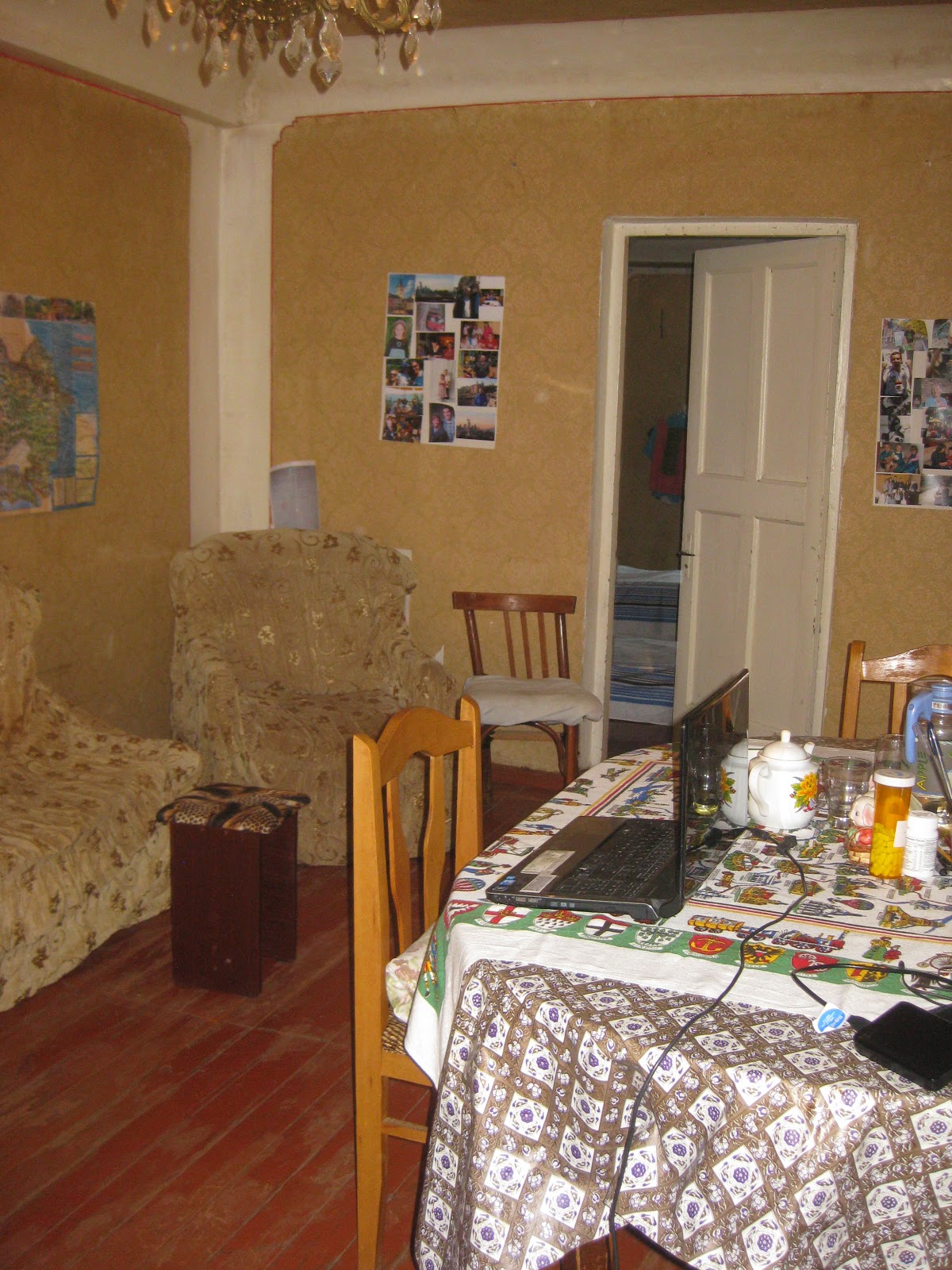
The living room is adorned with an ornate chandelier, sculptured and embossed (but very aged) wall and ceiling paper, and thanks to good friend and neighbor Gulnaz is now home to some of her spare furniture...

 View from living room into the spare bedroom

 Views of the living room, following the addition of some furniture and personal decorating touches (family photos, scenes from Washington, Oregon, and California, maps of Azerbaijan and the Caucasus region, and  sports posters)--Thanks to AzETA teachers for tables, chairs, kitchen and bath supplies. <3


 My only source of heat--small red space heater on the floor near the table...so far, so good


The guest bedroom *before*:
Guest bedroom *after*, complete with some wardrobe clothes hangers attached by twine to the curtain rod:
 View from guest bedroom into living room:

 My bedroom *before*:

And my bedroom *after.*
My old iron framed, bed-roll-for-a-mattress bed--cost 10 Manat, used, is draped with the Peace Corps furnished mosquito netting (there are some malaria-carrying mosquitoes in some parts of Azerbaijan, though not necessarily where I live; nonetheless, the mosquitoes we have are plenty pesky--and despite the time of year, they are still here!)  The apartment was totally unfurnished when I moved in, and typical of housing construction here, no rooms have any closets--people buy free-standing wardrobe closets.  Not being able to afford that on PC budget, I fashioned my own wardrobe closet, by hanging looped twine from the curtain rod, then bought some hangers, and now hang my clothes in staggered fashion:

 In lieu of a *real* closet, I hang my clothes on hangers, suspended with twine from the curtain rod.  For winter, I covered the windows with some plastic:

 A PCV leaving service gave me a chest of drawers with only two functional drawers; I made a bookcase of sorts out of the front panels of the two broken drawers, held up with boxes from the USPS, thanks to the care packages I get from home.  I have been inspired by how resourceful most Azerbaijanis are--everything possible is repaired and reused.  And my mom and dad, survivors of the Great Depression, would be proud, I think--they, too, were very resourceful, and taught me to use and re-use long before recycling was a commonplace concept.
 The front pieces of broken drawers serve as book shelves and dressing table...small hand mirror serves as my wall mirror


View from entry hallway into my bedroom:

 View from entry door into apartment hallway and beyond into living room...house slippers await guests; as is common here, one removes shoes and puts on slippers when entering someone's home:

View to entry door of apartment and my bedroom to the left.  The bedroom door at one time must have had a glass panel in it, like the door leading into the living room.  But when I moved in, there was no glass panel in the door, so I bought an Azerbaijani flag to cover the opening:

Hallway leading past bathroom on left into kitchen in background:


Scenes around the neighborhood:


Other Peace Corps housing options in Azerbaijan:
Some typical "Khrushchev Housing" in Sumgayit, Azerbaijan...typical Soviet-era mass housing complexes, minimal amenities, with fluctuating utilities--i.e. water only every other day or for a few hours per day. 

Typical "yard house" in small town :
Yard houses have bath and squat toilets in a separate structure in the yard
Yard toilet:

  
Villages and small towns typically have roads with brick walls, behind which are the "yard houses"; the elevated pipelines are for gas:
Small "yard house":
Built into the wall in the corner of the yard is the toilet:
 Spotless and well-maintained yard toilet:


"Yard" houses also commonly have separate bathhouses for "bucket" bathing or showering (hamam); room in back in this photo can be heated and buckets of hot water can be used for bathing, or some hamam have showers; sink in foreground is fed by water from a tin reservoir, mounted to the wall above the sink; it is filled from a hose in the yard, the only source of running water:
 

"Yard" houses are often heated by gas or wood-burning stoves called a peç:


Some schools, such as this one in a suburb of Baku, also have yard lavatories for the students and teachers (two small structures to the left of school building); no running water in the actual school building:

 School yard lavatory


Sunday, December 2, 2012

My Peace Corps Palace

Even before joining Peace Corps, I wondered--how do Volunteers actually live?  Well, Peace Corps requires that we live modestly in accordance with the place in which we find ourselves; we must adapt to the standard of living of the people we serve and with whom we work on a daily basis--yet it must meet Peace Corps safety, security, and health standards.  But since all PCVs are in developing countries, there are certain western amenities we do without.  There may or may not be reliable or regular access to electricity, gas, water, etc., for example.  So, in Azerbaijan, housing may be in a cinder block house behind a stone or block brick wall with a yard and a bath and squat toilet in a separate structure in the yard.  Or it may be in a large apartment building built during the 1950's and 1960's and beyond, known as Khrushchev housing--named after the Nikita Khrushchev, the Premier of the old Soviet Union, who had rapidly constructed low-cost public housing built to allow every family in the Soviet Union to have its own apartment.  Some of these structures were referred to as Khrushchev slums, and without maintenance today, they may have elevators which do not work properly, and a water supply that can be pumped up to the higher floors for only a few hours a day or every other day.  Separate homes today do not always have indoor running water either, so in both cases, one makes do, making sure ample jugs of water are always on hand.  And then there is my housing, in an apartment building built at the end of WWII by German prisoners of war.
Near the stairwell entrance is sheep's wool spread out drying--this is then used to stuff bedrolls, which is what most mattresses are made out of, that people sleep on.  Many families keep extra bedrolls handy, so they can roll them out for visiting family members when they come to visit from another part of the country.  Most towns and villages do not have hotels or motels for visitors.
In the yard surrounding the apartment building there are occasionally sheep grazing, and always some chickens and roosters, who seem to crow long before sun-up!  The chickens roam freely and have even followed me up the stairs to my third floor apartment--I didn't let them in!

Every morning sweeping ladies with twig brooms clean up the area around the apartment building.
 
Garbage from the apartments is tossed into piles near the apartment buildings.  Every day a dump truck comes by, the driver honks his horn to announce he is outside ready to shovel the garbage into the back of his dump truck.  However, there seem to be no land-fills, so the most likely disposal place is the river or banks of the near-by reservoir.
 My apartment came TOTALLY unfurnished...not even a stool, chair or refrigerator...I was fortunate to be able to furnish it thanks to donations from kind friends, students, teachers and community business leaders.  The apartment, circa 1940's had not been updated or remodel in years, and the exposed pipes and exposed, cracked, and deteriorating concrete walls proved to be a bit of a redecorating challenge...hence, some *before* and *after* photos...
 With some fabric with the traditional *buta* (paisley) design, I was able to cover up the most obvious flaws, and attaching it and making a back-splash with fabulous duct tape, greatly improved the kitchen appearance.


 /But the kitchen floor was so well-worn, I couldn't even hardly clean it, until I painted it with the ubiquitous red floor paint.

 Note the ever-common electric red oven.  Everyone has one--the gas-stove ovens don't work, or are too dangerous.  


 On top of my red oven you see the steel water filter, used to strain the boiled water, per Peace Corps health-guidelines...the Peace Corps furnishes us with the water filters.

One of my students, an English teacher from the Teachers' University, gave me her old Russian-built refrigerator...it works basically on and off, and the defrosting is by hand, something I haven't done since the 1960's.

 The bathroom *before* picture...followed by the redecorated *after* picture
 Because many homes have squat toilets, often those people who do have Western-style sit-down toilets do not use toilet seats, so it took some effort to find a toilet seat.  There were some used ones that I could have bought at the bazaar, but I held out for a new one, that I eventually found at a hardware store.
 This is the 'kalunka' in the bathroom, a water tank with a coil inside, fed by gas, and which once it is lit, heats up the water in the kalunka in about 15-30 minutes, depending on the gas pressure.  The first time I lit it, I experienced a minor (and scary)explosion, and flames shot out across the bathroom, filling me and the room with soot.  I soon got the hang of it, however (don't turn the lever on the pipe to the left of the kalunka too much, or too fast).
 Because the plaster was totally worn away around the shower exposing molding concrete, I created a new and water proof look with the ever-handy duct tape (thanks to Patrick McGinnis!)  The hook to hold the shower head also needed reinforcing with the duct tape, and I made a stable shower head holder by covering some egg-carton with duct tape and attaching strong twine.  It works!
 It takes some planning to do daily activities that we hardly give a thought to back in the States...for example, if I want to wash clothes and take a shower, it is best to plan to do both on the same day (conserving on heating up the water), but must have enough time in the day to heat up the water and also shower and wash clothes.  Hand washing is also an art, I found out, living with a host family.  The mom in the host family showed me the quick and easy, as well as 'proper' way to hand wash and wring out the laundry.
I can hang up the laundry on one of my two balconies--one open-air off my bedroom, and one enclosed, typical of most Azerbaijani apartment architecture.  However, in winter time, I must move the clothes rack inside, since in the cold it would take days for the clothes to dry outside.


More views of my Peace Corps Palace to follow...


Wednesday, November 28, 2012


http://www.youtube.com/watch?v=t8Vx48KtnWI

Working as a Peace Corps Volunteer in Azerbaijan, as well as in other countries that used to make up the former Soviet Union, has some unique and interesting challenges.  More than half the PCVs here serve in the TEFL sector (Teaching English as a Foreign Language), and one of the issues surrounding this assignment, that of the role of private tutoring as opposed to classroom teaching, is explained in this short video--an accepted concept that affects educational philosophy and practice, and which differs from what one finds and comes to expect in countries where public education is intended to fully educate students.