Wednesday, February 29, 2012

Trip to Oğuz and Şəki...or How I (Almost) Saw Russia from the Back Porch...

Trip to Oğuz and Şəki…or How I (Almost) Saw Russia from the Back Porch…last weekend.

The ‘back porch’ of Azerbaijan overlooks the countries of Russia and Georgia-- that is if you could see beyond the towering peaks of the Caucasus Mountains.  The Caucasus divide East from West, Europe from Asia (like the Urals), and from which the term ‘Caucasian’ is derived.  What glorious settings the towns of Oğuz and Şeki occupy!


The first adventure was to the town of Oğuz.  I departed by small bus (marshrutka-like) at 8 am, which follow a rugged but breathtakingly beautiful route into the heart of the mountains.  We passed small villages with small stone houses behind their small stone walls lining rugged, stone-filled, muddy paths;  we passed open fields and valleys with sweeping views of the mountains in the background; and we passed the occasional shepherd leading  his flock, as well as grazing yaks and cattle.  I must be getting used to these rides—I was hardly fazed by how cramped and crowded they are, fitting in as many people as possible.  However, good thing I got to the bus station early enough to grab a seat, otherwise the 2-hour ride to Oğuz might have been just a bit too adventuresome, had I needed to stand the whole way.  This particular route follows what is supposed to be a two-lane road, but it is so full of washed-out areas and huge pot-holes that the bus driver must proceed slowly with caution (good thing!) and swerve from one side of the road to another, just to find a decent surface to drive on…and so did the on-coming cars, too, which made it seem at times like a one-lane road, with cars heading straight for us (and us towards them).  Oh, the adventure of it all!  And since we were climbing closer and closer towards the mountains, the engine made very funny noises, indicating that perhaps our marshrutka was a bit too over-loaded for the climb, despite the down-shifting.  At one particularly steep point an on-coming car stopped our driver for directions; after obliging, the driver had a moment where it didn’t seem like our rickety bus was going to be able to get going again.  Well, we did, and soon I found myself in the little town of Oğuz.  It reminded me of little towns in the Rockies, so gorgeous.  After getting directions to the Olympic Complex of the town, I met up with other Peace Corps Volunteers for the youth Frisbee camp and tournament.  I even tossed the Frisbee around some, too, inside a huge gymnasium (but surprisingly NO basket-ball hoops or courts in this gym).  But I mainly participated in spurring on the other PCV’s and Azerbaijani youth in their games.  The team from Oğuz was spectacular, and they won!
 Road as seen from the mini-bus (marshrutka)
 My PCV friend Kathy and I decided it was about time to head to Şeki, which is about an hour further towards Georgia from Oğuz, and which is where she is spending her PCV assignment.  But first we joined up with another PCV Stephan and LCF Tural for a hike to a hill-topped abandoned pilgrimage chapel, most likely an Albanian Caucasus Christian Orthodox church, now in semi-ruined state.  Nonetheless, followers still come and leave red wish-ribbons tied to the tree by the door, believing that when they blow away in the wind, the wish will come true.   Interesting also is the fact that Oğuz has two synagogues, one still active with a congregation…this is a region of ethnic Udi (Christians) and of so-called Mountain Jews, which have co-existed here for centuries.
 Oguz

 Ancient Udi pilgrimage chapel

 Red ribbons tied to branches on tree at right of little church represent wishes, which 'come true' when the wind blows them away
View in Sheki
I loved staying in Şeki.  Kathy lives with a wonderful host family in a centuries-old house, not far from the Caravansaray (the over-night stopping place for those riding along the Silk Road with their camel caravans centuries ago), which today has been converted into a hotel in which to stay, just as in the days of old.  Also centuries-old, is the spectacular Khan Palace further up the hill-side, so marvelous in its design, with beautiful colored windows and walls.  Many scenes on the walls depicted trees of pomegranates, thought to be the fruit of kings, because they are topped with little crowns—look for that, the next time at the grocery store.  Şeki has steep and winding cobble-stoned lanes and alleys, so charming, but also still a bit treacherously packed with snow and ice. (Mingechavir’s weather, being much milder, has not had snow or ice for several weeks, but I forgot about Sheki’s mountain location, and didn’t think to bring the right boots—ah, well…)  The house in which Kathy lives is truly interesting…like many centuries-old homes in Europe, the doors are small and low—so much so, that even I, small-statured as I am, had to duck in the door-ways!  The squat-toilet is outside, built into the stone wall of the yard; there is a sink to wash near the outdoor bucket-bath bathing room, but that sink wasn’t usable, since the water in the small metal reservoir above the single spigot, was frozen.  So you wash and brush teeth in the kitchen, which also has a single spigot faucet below a metal tank, which holds the water (cold!).  To get to the bedrooms, you go outside and up some stairs, and walk across a veranda to the several bedrooms.  Each bedroom, as well as the living room, has a small gas furnace, which in earlier days might have been a wood-burning stove.  The mom in Kathy’s host family is delightful and genuinely hospitable.  Before İ left, she pointed us in the right direction for the shop with the best halva—the local pastry specialty, a fancy version of baklava and most tasty!  I had a great time, but also made a work-related connection with Kathy’s Azerbaijani counterpart, to possibly in the future work on ways to help advance the English instruction in the orphanage and internat that his non-profit organization helps support.  It was a wonderful, worthwhile weekend in many ways.
 
 Road to Kathy's work-place

 Exploring the Caravansaray

 The Palace of the Khan


 Kathy's house in Sheki 

 Kitchen...no running water inside the house, tank above sink holds water filled by bucket, turn faucet on spigot when needed
 Hall-way
 View of courtyard from balcony (veranda); red door in background is for the toilet room
 From the balcony
 Washroom in corner of court-yard/bucket bathroom, sink with tank-reservoir
 Kathy's house in Sheki

Monday, February 27, 2012

Valentine's Day and other celebrations...

 Last week was Valentine’s Day, and one of the teachers with whom I work gave me a very nice souvenir of Azerbaijan—a little statue showing Azerbaijani musicians playing the traditional Azerbaijani folk instruments.  Then the students in her class also gave me gifts—a snow-globe heart with the Shrine of Mecca inside, and a place to hold my pens/pencils, as well as a desk clock with Arabic writing (from the Quran, I believe), but when I asked what it meant, no one knew—here everyone of course speaks and reads Azerbaijani and most also know Russian, but not Arabic.  I was overwhelmed at the gifts—and that they even knew about Valentine’s Day, but that is primarily due to the teacher who has had a lot of contact with Peace Corps Volunteers for a number of years.  They told me they sought out items they didn’t think I’d easily find in the States!


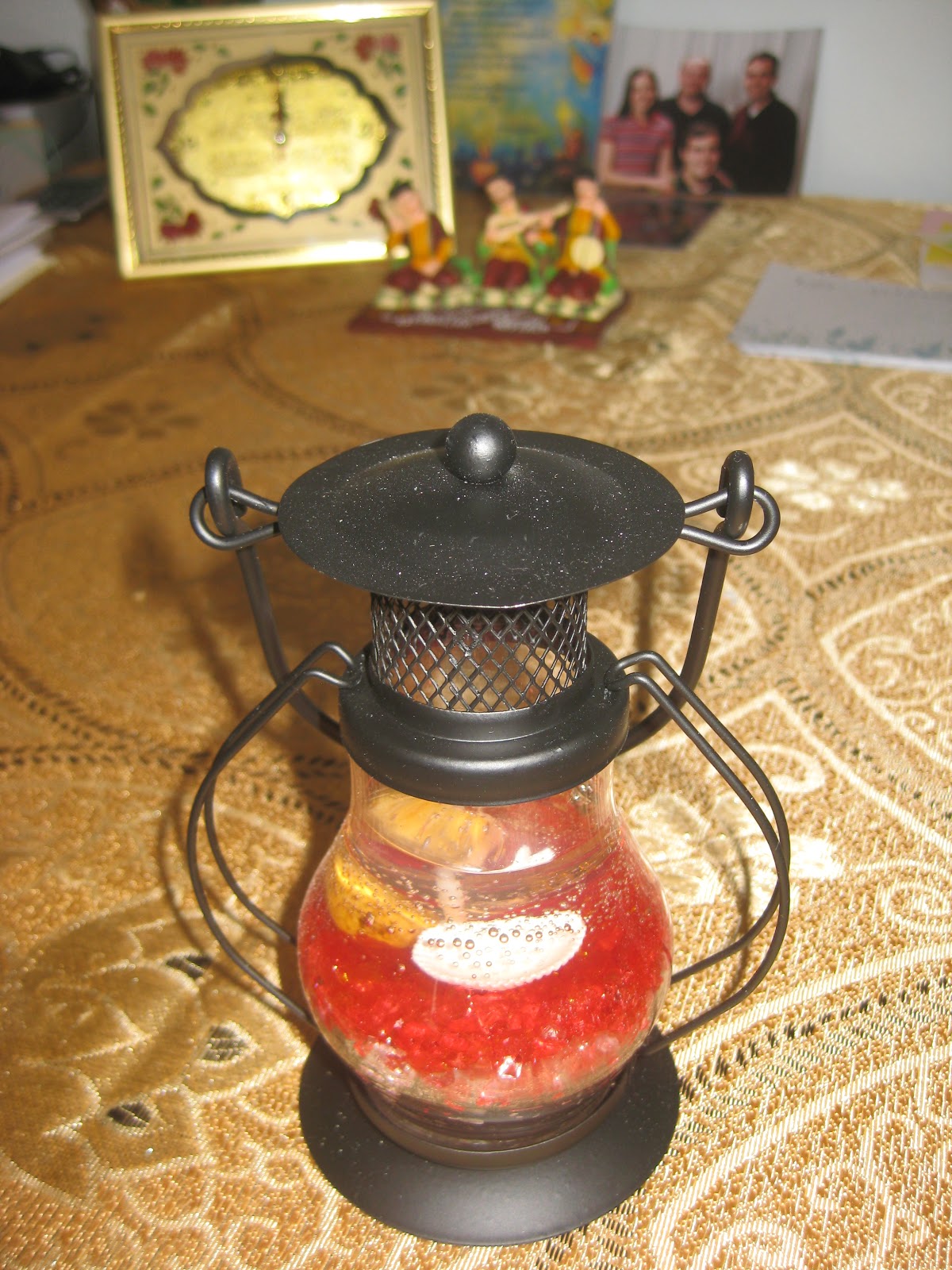
Last Monday the father in my host family returned from more than three weeks in a sanatorium in Baku.  He underwent some ultrasound tests and then weeks of recuperation and rest.  Exactly what was wrong is not openly discussed, but he has been declared fine.  Upon his return, he brought gifts for everyone—including me!  A little candle in a glass lantern.

A week ago Saturday I went to the post office because the post master told another Peace Corps Volunteer to let me know that I had a letter.  And so I did, the beautiful save the date photo card from Robby and Audrey!  (Caused me even to tear up a bit.)  I was on my way to the Teachers Conversation Club of Mingechavir at the time, which is one of the groups I lead.  The card presented itself as a good teaching prop—I was able to share it with them and with the teachers from AzETA (Azerbaijan English Teachers Association) who met later in the day with me; I explained some of the skyline of Seattle and the family significance of Kerry Park and its sculpture. One conversation activity I employed required that I leave the room, while the group picked a word or phrase for me to then guess, based on their descriptive clues—a variation of ‘20 Questions.’  They gave me many interesting hints, thereby practicing good English, before I guessed the phrase they had chosen—“getting married!”  Aw…  In my host family, nine-year-old Farida is a budding artist, and her favorite drawings are of fashion and fashion models...
 Farida's depictions of Audrey and Robby...

and those who will be in attendance...

Last week, while working in my room, a student came in to chat, but upon noticing that I was eating a snack, asked me if I was hungry (it was still early in the day).  I said, well, yes, and she left the room.  A few minutes later she returned with 2 piroshkies and cakes that she had bought from the canteen for me to enjoy!  I was so surprised.
 
As always, these family relationships, personal relationships, the hospitality and generosity of the people provide positive examples of the rewards of Peace Corps service.  And more will surely be soon in store, since preparations have started for Azerbaijan's most loved holiday--Novruz!  It celebrates the start of Spring, and each of the four Tuesdays leading up to Novruz acknowledges the elements of water, earth, fire, and air.  Last Tuesday was water, and tomorrow is earth Tuesday.


Friday, February 24, 2012

Birthdays

Last week was the birthday of the father in my first host family in Masazir.  I gave the family a call to sing happy birthday over the phone (I omitted singing our family-favorite from Big John and Sparky days, “Today is the Day, I Wonder for Whom…”don’t think it would have gone over quite so well).  They proceeded to tell me over the phone that they miss me, and wonder when I will come to visit.  Well, I miss them, too, and hope to visit them again; then we had a good laugh over the fact that every other day is still ‘elektrik yoxdur’ – no electricity in Masazir—good thing they have a good sense of humor and carry on.

Sunday was the birthday of the mother in my host family, and relatives from other towns in Azerbaijan and from as far away as Moscow  arrived.  She  prepared a big feast of typical Azerbaijani foods, and I helped the other women with the Nar Salati and the Mimosa Salati, though peeling the pomegranates is time consuming; while doing so, I kept thinking of the big tubs of peeled and deveined pomegranates available at Costco—no Costco here, not anything even close to a Costco!  From one visiting family is a little four-year-old boy who hid every time he saw me…understandably, I am different—and look different—than everyone else.  But he smiled and laughed each time--he is so cute, and before the weekend was over, we were friends.  It turns out that his mother is the cousin AND the sister-in-law of the mother in my host family—Vusala-- whose birthday we celebrated.  Not uncommon here, Vusala’s brother married a cousin on the mother’s side of the family. 

The father in my host family announced the gift he would be giving his wife—a sheep for the backyard!  Not your typical birthday present in Seattle!  But she seemed very pleased.  What I did not originally understand was that the men were leaving right then to go to the market to buy the sheep.  Soon it was in the chicken coop in the backyard, and I was invited to come out and take a look…I brought my camera.   The father and little seven-year-old Ibrahim were busy trying to coax the sheep out of the coop when I arrived; as I got closer all the chickens flew out in a wild frenzy.  Then the father grabbed the sheep by its front hooves and pulled it out of the coop, dragged it across the yard to near the patio, and we held it firm as we posed for photos with the sheep.  I thought it was going to be a new family pet.  I was wrong!


Soon Ibrahim fetched some twined and the father wrapped the four hooves together, laying the sheep on its side.  While Ibrahim held the hooves and body firm (this took strength from the little seven-year-old), the father took out his butcher knife.  In less than a minute it was over, and the head lay on the ground next to the body spewing blood.  It happened so fast, before I realized what was going to happen, but I witnessed the whole thing—not for the faint of heart—and when it was all over, the skinning of the sheep and the butchering was made easier by stringing up the carcass on a pole in the yard; the whole process reminded me of dissecting class from college Biology.   At one point during the skinning, the family pet dog got a hold of one of the sheep’s testicles, which had been discarded into a pan on the ground, while the strung up sheep carcass was being properly butchered.  The dog was reprimanded severely with a thrown rock striking it in the hind leg, causing extreme yelping and hobbling.  Later, the pet dog (Ninze) fortunately seemed OK again.  Soon the meat from the sheep was skewered and on the grill; the men gathered round and sampled the first skewers together with a glass of red wine; interestingly, the wine goblets were first rinsed with very hot water so that the wine from the cold bottle could be warmed—here it is considered very unhealthy to drink anything cold!   Hence, hot tea is the drink of choice in winter and in summer, and the concept of iced tea makes most Azerbaijanis shudder.  Later during the evening meal, everyone had some juice, to which the mother added some hot water from the tea kettle off the stove, to make sure we didn’t drink juice that was cold.  The children gave their mom some new bottles of perfume, and I gave Vusala a set of coasters, hand-made, from Kathy—she was very pleased, thanks Kathy!—and also gave her some of her now favorite chocolate that I have introduced her to—Rittersport from Germany!  Fortunately, I found out later, that I showed respect and honor by partaking of the skewers of mutton, but was likewise honored and shown respect by being invited to watch the slaughtering.  It is not an uncommon sight for Azerbaijanis, since every November for Qurban Bayrami, the Holiday of Sacrifice, a sheep is slaughtered as a religious ritual for sacrifice.

It always is a wonder to me how much Azerbaijanis are able to do for themselves…they know how to slaughter and butcher, and they build and remodel their own houses, too!  Amazing!   


Preparing the sheepskin...


The ingredients for national dish...Xash

Chickens enjoying innards...

Skewers on the barbeque

Mimosa Salad
Nar (Pomegranate) Salad

Friday, February 17, 2012

President's Day...February 20, 2012


Every Peace Corps Volunteer has his or her own reasons and motivations for joining the Peace Corps.  It is an arduous process, right from the outset, so one does not enter lightly.  There are numerous application procedures, letters of recommendation, essays to write, interviews, medical clearances to receive, so for many it takes about a year, just to receive the invitation to join--and given federal budget cuts, it is not all that easy to receive such an invitation.  Following the invitation to join come weeks of preparation, followed by months of training. Some surely decide early on, it is not worth the time and effort.  But for those who eventually do depart for regions unknown and for work yet unknown--"for the toughest job you'll ever love"--the rewards can be great.  And yet, despite the worthiness, the challenges during the years of service can also be so great, that one may often need to be reminded of one's original motivations to give up home and family to serve in a developing country.

I need only think of Bill, and in whose memory I dedicate my service.  One cannot have spent more than 40 years living with someone so kind and thoughtful of others and not be somewhat influenced by his outlook on life.  And so it was with Bill, who left us all too soon, on February 20, 2010, but left with an inspiring, noble legacy of service to his fellow man.  He surely had special innate gifts of selflessness and loving spirit towards others.  In high school, Bill was recognized by the Rotary for his 'Service Above Self.'  As a struggling graduate student, he purposefully searched out a way to find those who could benefit from his generous spirit, and so he became a 'Secret Santa' through the postal service's Operation North Pole, buying and gifting presents for needy children, when he himself only lived off a small stipend.  But mostly, Bill gave the gift of his personal time and organizational skills to help others.  Over the years, through the Seattle Milk Fund, the Salvation Army, the Kiwanis Club International, as well as through his own personal initiatives, he promoted and supported schools and villages in Africa and Central America, international campaigns to improve the lives and health of children, as well as help schools and youth, needy families, individuals, and recent immigrants in various parts of the U.S and in neighborhoods of his own community.  Before he died, he laid out plans for the future, which he hoped I would be able to fulfill in his stead.  In a small way, I hope my service honors the memory of Bill and his philosophy of life--placing the needs of others first and doing one's best to serve.  And so on President’s Day, 2012, I will honor in addition to the memory of our Presidents, also the memory of one who was president of several community service organization, president of his business, and president of goodwill in the hearts’ of many.


Tuesday, February 14, 2012

Here Comes the Bride

Here comes the bride…

The roles of men and women here are very specific and well-defined, steeped in traditional values meant to hold the society together for the common good.  And in traditional societies, customs are strong societal  virtues, holding more value than in America, which is a less tradition-bound and more fluid society, valuing often more that which is innovative and individualistic than that which is traditional and communal.  The customs here are therefore quite different than what we know in America.  After formal schooling, with rare exception, males and females do not socialize, and even find it awkward to communicate with each other.  A woman, for example, may not even find it comfortable to speak to a man on the phone or on the street to ask for, or to offer him, something as simple as directions.  (These are the reasons women do not go into internet cafes or tea cafes, places where men gather.)  Most common decision–making and information asking or giving—such as directions to one’s home-- is deferred to the man of the house.  And virtually all children, even adult children, follow the decisions made by their parents—regarding their schooling, their free-time, where they live, their jobs, and whom they marry.  It is not so much that parents control with coercion the lives of their children, but rather people defer out of love and respect to their parents’ wishes and advice on almost all matters.  In similar fashion, students defer to their teachers—most classroom learning is rote memorization, decided by and dictated by administrative decision-makers—critical thinking skills and creative learning are concepts that are being introduced where possible, but are not yet a strong part of the educational tradition.  Following tradition, as well as pleasing and honoring the wishes and advice of parents and teachers, is what everyone here expects and is used to.  In America, we have all been raised at an early age to figure things out for ourselves, make our own decisions, and this individualism and independence is prevalent in all aspects of our culture, influencing education, family life, marriage/wedding customs, and on into old age.  But in Azerbaijan, where virtually everyone is expected to be married by mid-twenties, many customs are designed to reinforce the traditional way of doing things.  Parents guide, protect, and make decisions for their children throughout their lives.  Children marry and have children of their own.  And when old, people are cared for by their adult children—in their homes.  A few old-age institutions do exist, but only for those deemed very unfortunate to have never had children of their own to care for them.  (It has even been suggested to me that some of my own children are disrespecting me by choosing to live so far away from my home!—'Who will take care of you?' they ask me!) This explains in part the importance of marriage and the likelihood that parents will influence the choice of marriage partners—it represents a security for society.

Recently someone I know has become engaged, and I know the customs surrounding this will interest some…so, listen up, Robby and Audrey, and et.al.—you know who you are ;-).  Customs here are fascinatingly different.  Marriages are often quasi-arranged, and in this case here, the young woman became acquainted with and spoke with her now fiancé for only several weeks prior to the announced engagement.   Marriage is considered so important, that the Azeri word for ‘unmarried’ is also the word for ‘homeless.’   Some parents make plans to buy a small apartment for their marriageable child, to enhance their marriage-suitability, or they arrange for space in their own home—often newly-weds move in with the groom’s parents, until they can arrange to afford their own place. Television programs devote hours every day to helping people find mates, and to celebrating televised marriages so that even those at home can rejoice and participate, dancing along to the traditional wedding dances in one’s own living room.   In villages it is still common sometimes for first cousins to marry each other, though, as it has been explained to me, it is only considered OK for such a marriageable cousin to come from the mother’s side of the family, since it is believed that blood and blood-type is inherited only through the father, and therefore a cousin from the father’s side would be a genetically unwise prospective mate.  In many cases, a young man desirous of finding a mate—or feeling pressure from his parents-- may see a picture of a local girl he finds interesting.  He may then find out where she works or lives and arrange to catch a few glimpses of her.  If still interested, he may find out her phone number and give her a call.  If she, too, is interested after talking to him, for several weeks they may talk on the phone—but not meet or go out in person.  In other cases, the couple may have known each other from school-days or from the town, and now that they are of marriageable age, they simply decide (or their parents decide) that they should plan on becoming engaged.  At this point it is then agreed that the parents should formally meet to discuss whether or not the boy and girl would make good marriage partners for each other.  The first meeting may just be between the boy’s parents and the girl’s parents.  It is a time to find out more in depth the family background, and if the young people come from reputable families.  Family reputation is very important, more important than one’s career or academic successes—hence sometimes it is considered desirous to match up cousins, where the family reputation is mutually shared.  If the first meeting results in a favorable impression on the part of the parents, the prospective bride’s parents invite the boy’s family once again.  This time a few more female family members might be included—grandmothers, aunts, female cousins.  At this second meeting, a special tea will be served.  If the tea is very sweet, it means that the bride’s family agrees to the wedding engagement; if not, an unsweetened tea will be served to the boy’s female relatives.  Everyone understands the significance of the sweet/unsweet tea, and realizes also it is too impolite to directly say “no,” in personal matters such as this, just like in commercial business dealings (as I have previously described, directly saying ‘no’ is culturally very inappropriate; a young girl, interested in a man as a prospective fiancé, may even have a family member approach her father to ‘ask’ the father’s opinion on the matter; this way, if the father does not approve, both father and daughter are saved from the embarrassment that might be caused by having the father directly refuse with a ‘no’ answer.)  Now that a sweet tea offering to the prospective groom’s family has been made, an official engagement party may take place.  In the weeks following, the young couple may actually begin to date or go out with each other, in order to get to know the person that they (and their respective families) have decided they should marry.  The young couple may meet for tea at a restaurant (there are a few in Mingechavir where women would not feel out of place), or they may meet by the river, and spend some time talking about and planning their wedding.

Weddings in Azerbaijan are most elaborate.  They are held in huge “wedding palaces”.   These types of weddings are meant for 500 or more to attend; every evening on TV there is a complete section (about 15 minutes) of advertisements dedicated to the wedding palaces, and they are truly very large and very fancy establishments.  Even small villages have wedding palaces.  The events are catered with lots of specialty food and national dishes.  Traditional music is always played and traditional Azerbaijani dancing is for everyone who attends.  For most of the wedding, the bride and groom sit at a table on a small stage above the crowd, but they do join in the dancing, too.  All photos of the couple show them and other family members with solemn looks on their faces—not because the occasion isn’t joyous, but because it is also serious, and it is customary for people not to smile when have photos taken.  Obviously the events can be so large that some people have two weddings—one for the groom’s side of the family and one for the bride’s.  And they are surely very expensive.  As a result, it is customary for people invited to a wedding (which is called a “toy” in Azerbaijani) to put money in an envelope to pay for at least their own meal at the party.  This is often in lieu of a gift, since most brides enter into a marriage with a dowry of items to set up house-keeping,  that have been prepared and set aside for her since her youth.  Gifts, therefore, are not so important, nor necessary, but money to defray the cost of the celebration is expected, and tabulated.  Some business people can be invited to many weddings over the course of a month, to the extent that much of their monthly salary could go towards attending the weddings of the children of business associates.

Just before the wedding, the bride’s best girlfriends/sisters hold a “henna” party for her…the Azerbaijani bachelorette or hen party is truly a party with henna.  Elaborate designs may be drawn on her hands and wrists, and sometimes her name and the groom’s name will be drawn in henna on the girl’s palms and wrapped then with a red ribbon.  It may stay this way until the next day—the day of the wedding.  The boy, too, has a bachelor party of sorts, but here it is traditional for the groom’s best friends/brothers to take him to have a bath--it may be at an elaborate and expensive Turkish bath establishment, as in Baku, or it may be as simple as the shower of a friend’s apartment.  The idea is to wash off all bachelorhood and prepare him to be clean for his bride the next day.

Every day one sees wedding cars driving down the main street headed for one of the wedding palaces.  They are decorated with flowers or with tulle netting tied in fancy bows encompassing the car(s).  One of the wedding palaces here in town is all lit up at night with neon lights to look somewhat like the fancy hotels of Las Vegas.

Well…more will follow, as the wedding of my friend approaches…

 Wedding dresses often have red sashes, which represent purity, and are removed as part of the wedding celebration, similar to removing a bride's blue garter...
 Wedding cars, decorated...

 One of Mingechavir's wedding palaces, lit up with red, blue, green, and yellow neon lights at night, reminding me of Las Vegas hotels...
 More bridal gowns for bride and attendants


Wednesday, February 1, 2012

Getting down to business...


Doing business in a foreign country has some challenges, but foreigners often have challenges understanding and doing business with Americans as well.  Often this is due to misunderstandings rooted in cultural values and differences.

Some years ago, Bill’s company did business with a factory in Japan.  Bill very wisely decided that he and I should take some Japanese lessons, to learn how to communicate ever so slightly, but thereby show honor and respect to the Japanese factory representatives, and to learn about the business culture in Japan.  Indeed, the officers of the Japanese company were pleasantly surprised, because we were the first Americans with whom they had done business, who bothered to learn how to speak (albeit very little) Japanese.  We also learned that in their society, as in many other societies, it is more important to follow certain social norms of politeness, say pleasing things to guests, and always imply “yes” out of respect.  It can be considered insulting to outright say “no” to guests (even if a “no” is exactly what is meant).  Understanding this turns out to be very important, if one does not want to end up very disappointed because of not just a language misunderstanding, but also a cultural misunderstanding.  It did not happen to Bill, but one of the other American companies which also dealt with this Japanese firm had exactly one such disappointment.  The American salesman was pleased that in his meeting with the Japanese company representatives, it seemed all was O.K. for a signed deal for a big order that he felt had been negotiated; the Japanese had smiled, shook hands, nodded “yes,” and the American went home, very pleased with himself.  Once home, he found out that he did not have a deal at all, and that no contract was going to be signed.  He was angry and felt deceived.  Lesson learned:  in many cultures around the world, it considered too impolite to say “no” directly to a request from someone; within the society, one might well-understand and accept this, so that one does not necessarily expect that which, out of politeness, was only superficially implied.  People in parts of Asia, as well as in this region of the world, realize that “saving face,” being polite, and not out-right refusing someone by saying directly “no” is so important, that people here are not necessarily offended or surprised, when an arrangement doesn’t materialize, as an American might expect.  An American business person might take such offense and even exclaim that he/she was lied to—but this attitude makes American business people in return seem ruthless, heartless, and certainly not in tune with the fine nuances of being polite.  Ah…lots to learn.

We’ve been trained to expect and show understanding for these cultural differences, but the challenge is great, when it happens to you personally.  Some months ago, I thought some local friends had arranged for a taxi ride for me for an agreed upon price.  They told me, each time I pressed for a definite commitment, oh, Mary, don’t worry, it will work out--this taxi will take you and charge you what you are expecting.  Day came…the taxi was not arranged for, at least not for what I thought was the agreed price.  Quickly, I had to make other plans.  Culturally, it was simply not polite to flat-out tell me “no,” when I ask specifically, and it was considered culturally appropriate for them to help the taxi driver (a neighbor) also “save-face.”

One obvious cultural difference here is also the concept of individual privacy that we Americans value.  This is very prevalent at the ATM’s, which is how most everyone here gets paid—money is deposited into one’s account, and once a month one draws it out in cash; since this is totally a cash society (outside of Baku), everything must be paid for in cash, no credit cards.  So, as one is accessing his or her account at the ATM, half a dozen or more people may crowd around, watching, even offering to help enter the pin numbers!  I think the idea is, some people are just too slow, and it would speed things up, if the individual would just get some friendly help from one of those watching and waiting, huddled around at the ATM machine; they truly hover over people who are at the machine, and the concept of waiting in line or queuing up does not exhibit itself very often.  Personally, it makes me uncomfortable—and I have had people ask if they could ‘help’ me enter my information and pin!  I huddle close to the key-board, and certainly do my own info and pin entering, but I have seen some others gratefully accept this help, unconcerned about this as possibly an invasion of privacy or worse, identity theft.

This is country of very gracious people, well-known for their hospitality, especially to guests, and as a foreigner, great kindness has been shown to me.  However, uncommon for an American are all the personal questions one is asked, and from an American point of view, sometimes bordering on an invasion of privacy.  For example, a stranger, or someone I just met, might ask me right off the bat how old I am, what  my family status is, how much do I weigh (!), and many other personal questions about myself, my family, my living conditions, etc.  But these kinds of questions imply here a kind of compliment, because they indicate that you are interesting, interesting enough to warrant further information.  And, furthermore, as an American, I draw an inordinate amount of attention and curiosity.  I am frequently greeted by people on the street, by name even and by people I do not even know, because I have become somewhat well-known, and, well, I definitely look foreign—so I am an object of curiosity.  However, even understanding this, I cannot help but sometimes feel the curiosity goes too far…like the time recently, when my personal letters and sensitive mail from Peace Corps were delivered to my work and were opened, taken out of their envelopes, examined and read.  I realize even the educated people at the university where I work curiously find me extra-ordinarily interesting (or perhaps even view me with some suspicion). But even here an invasion of private mail and sensitive correspondence is probably not acceptable!  And further, the explanation that I was given—‘they were all opened by mistake’—was also not very satisfactory, since that was simply not true (from my American point of view, a lie even); all the mail was clearly address to me, Peace Corps Volunteer, it was impossible to have been a ‘mistake.’  Sometimes it is almost too challenging to accept the fact that such an ‘explanation’ is meant to save-face and protect the perpetrator, whose curiosity could be locally considered understandable, even if such curiosity was also too great.  Protecting the communal values does supersede the independence and individual rights that we Americans come to expect… It is particularly challenging to know when to accept with understanding the cultural differences, and when such differences are outright unacceptable.  This challenge is especially great in developing countries where knowledge of the outside world and Western cultural values may be somewhat limited, and therefore mutual understanding cannot be expected.  To succeed personally, or on a business level, and even on a diplomatic level, it is often necessary to extend an inordinate amount of tolerance and understanding for cultural differences.  But also know when things have gone too far.  Opening and examining sensitive and personal mail from Peace Corps qualifies as the latter, I think.

Of course the main way I conduct business on a daily basis is at the bazar—the outdoor markets, where just about everything is sold.  Bartering for price is the norm, and even though, thanks to my great language tutor, I can express myself in the bartering process, it still feels odd—prices are never marked, because you are supposed ask the price and then negotiate down from there.  It takes some getting used to.  Some more interesting views of the markets, etc:

 Random cow and geese on my street
 Apple truck in the apartment housing area...bringing the produce to the buyer
 At the Butcher's...hooves on the table and hanging from hooks on far left, head on ground by pole lower right, the rest hanging in the middle
 Shopping
 Washington State apples...well, they're Delicious at any rate