Friday, May 18, 2012

Business Dealings...and many photos

Business Dealings...and many photos...

Living on my own has introduced me to a few more new things about doing business in Azerbaijan.  Every apartment dwelling and home has an electric meter box, with a small padlock.  To ensure that you always have electricity hooked up to your place, you must load a credit/debit-type card with money, unlock your meter box, and stick the card into a special slot, thereby electronically adding funds to the account associated with your meter box.  This sounds simple and easy, until you actually try to load the money onto the card.

First, you must go to the post office, where everyone gathers and crowds around, trying to get money put onto their cards, too.  There is no such thing as standing in line or in a queue for anything in Azerbaijan, and so it is also at the post office.  You just try to work your way eventually to the front in order to reach the counter, where you hand the clerk your money and your card.  On a very old, slow dot-matrix printer, she prints out how much money you paid, and hands you back your card and the receipt.  Then you go to another part of the post office and crowd around yet another counter, where you can eventually hand this second clerk your card and your receipt; he then records everything (by hand) and lays your card on a small indicator machine, which records onto the magnetic strip how much you paid, and loads that amount onto your card.  Then you can take your card home and insert it into your meter box.  It is not a very expeditious system, and I understand that in Baku there are now some kiosks in market stores, where you can do this automatically.  Interestingly, this seems to be the main function and purpose of the post office.  No one here has a mail box, there is no home delivery, and in fact people in general do not send mail or use the post office for anything other than paying utility bills. All the mail I receive here I pick up myself from the post office; I stop in every few days, just to see if I have any, and have gotten to know the man in charge of keeping our mail until we call for it—he wants me to take him to America when I leave!  Many Azeris don’t really even know their own addresses or how to write it, because it is unnecessary to know—you never record it anywhere, because mail is not used for communication (cells phones are), nor for paying bills. Gas bills, too, are paid at a bank or post office.  The utility bills, other than electric, are stuck on your door, so you know what to pay and when.  Everything else, like these bills, is paid for in cash.  There are some places in Baku that accept credit and debit cards, but in Mingachevir, as in all other regions of Azerbaijan, this is basically a pay-in-cash-only society.  Crowding around in the post office or bank to pay utilities, though by our standards time-consuming, suits the way of doing things here—never in a rush, always taking time to chat with neighbors and friends—so none of this is seen as a nuisance, but simply the way things are done!  Besides with very high unemployment, most men spend their days sitting with friends in the Cayxana (tea houses) all  over town…chatting away, playing nard, taking it easy—life in a rush or on a set time-table is not part of how business is conducted here.

Several weeks ago, I had the honor of interviewing finalists in Baku for the SUSI program for Azerbaijani university students to spend six weeks in America, to learn about democracy, civic engagement, leadership, social responsibility.   Supported by the U.S. State Department, this is a wonderful opportunity for Azeri young people to learn first-hand the kinds of things necessary for them to help their developing country continue to move forward.  I was thoroughly impressed with their enthusiasm and the command of English of most of the applicants.  I wish them all well.  Again I marveled at the sights in the center of Baku and its old walled Icheri Sheher (Old Town); I enjoyed another concert at the Filharmonia and an ice-cream sundae at McDonald’s—just like home.  Then it was time to climb back onto a crowded, worn, stuffy and hot marshrutka for the bumpy ride back to the ‘real’  Azerbaijan, the Azerbaijan where Peace Corps works.  But it was good to be back home in Mingachevir and the job at hand.  I’ve held some more well-received training sessions and traveled with my friend Gulnaz to Sheki to visit a colleague—productive times=good times.
 Conducting a Training Seminar
 Scenes from Beautiful Baku


 Around the stone-wall fortifications...there used to be a double-moat, one filled with oil, which could then be set a-fire to turn back invaders--I bet it worked!


 The Filharmonia...concert hall


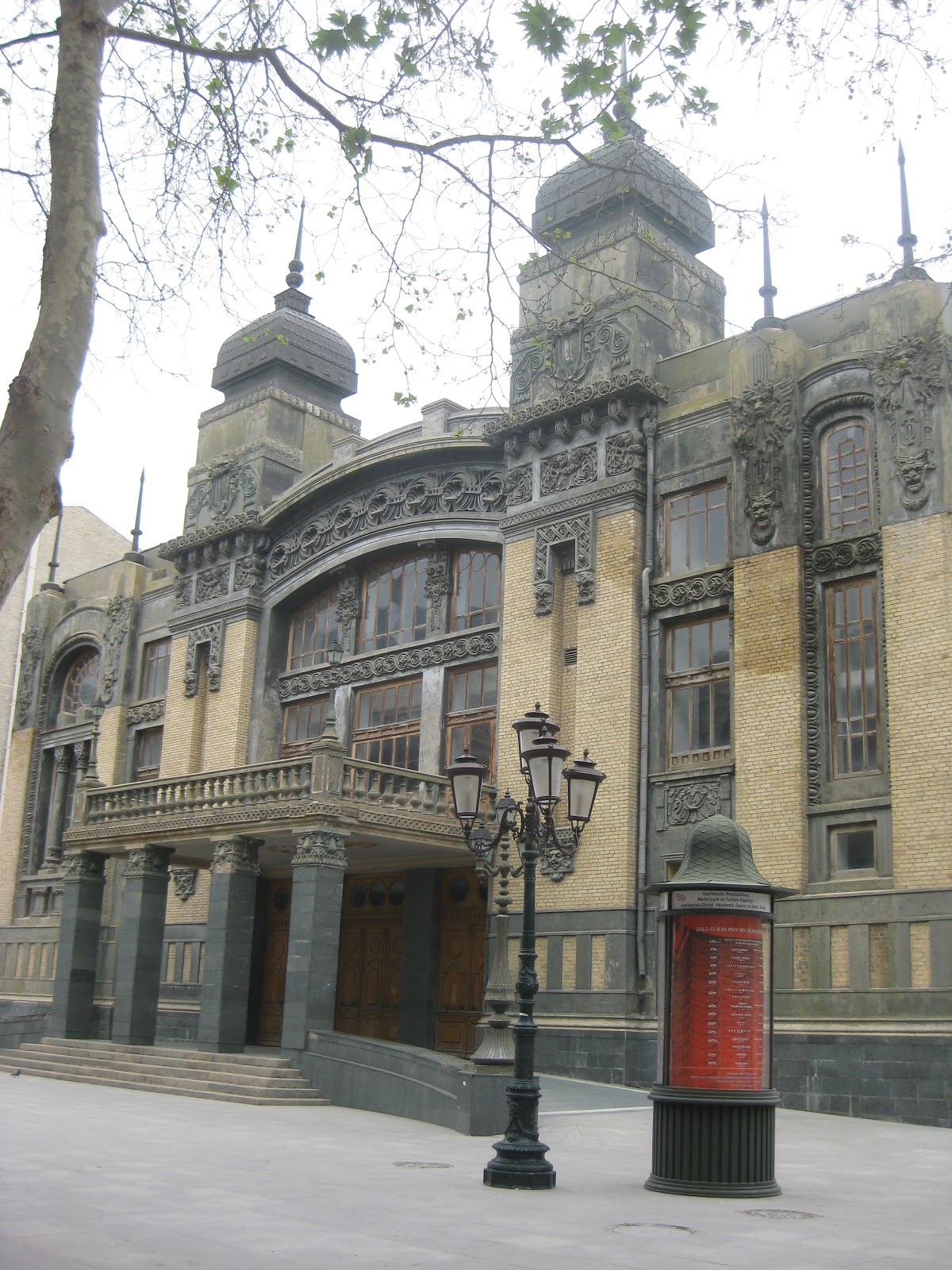
 The opera and ballet theatre


Literature museum
 Rural life...and rural road 'jams'

 Scenes from Spectacular Sheki...the old caravansarai--the hotel/stopping place for Silk Road caravaners.


 Sheki halvasi--their special baklava


 On the grounds of the old caravansarai
 Their tea-house
 Typical road jams

Back home at my apartment building, my apt. is top floor center with the wood-framed balcony, note pile of newly sheared sheep wool drying in the sun in front of the building stair-well entrance

Friday, May 11, 2012

Mary's Moving Day...and More Holidays


Moving Day…and more holidays

In Azerbaijan, every day that can celebrate the late Hedar Aliyev, father of the current president and considered the father of the nation, is turned into a national holiday.  Every town, every village, every road in Azerbaijan has reminders of him…parks, statues, billboard photos, memorial museums, streets and boulevards, all in honor of him.  So this past week there has been another such celebration, this time his birthday (in December it is his death day).  On these, and other national holidays, it is common for schools to let out, and all teachers and students walk en masse to the huge statue of him in his park in the main part of town and there lay bouquets of flowers before his statue.  It so happens that his birthday also falls on the same day as National Flower Holiday, May  10; this is particularly nice, as most schools decorate placards and other displays of flowers depicting scenes of the town, Azerbaijan in general, typical customs and Azerbaijani accomplishments, and of course Hedar Aliyev.  It was a hot, sunny day, and the displays were beautiful, as were the darling school children in national costume, dancing in the center of the town to typical Azerbaijani music.


 University students showing off the Youth Group display
/

The crescent and star symbol from the Azerbaijani flag reminds me of the Tri-Delta pin


Peace Corps Volunteers and Hedar Aliyev

The day before, May 9th, is also a national holiday, marking the end of World War II (in Europe), or as it is referred to here—the great German-Soviet War.  Although Hitler’s army never made it as far as Azerbaijan, he had his sights on it, because of its natural gas and oil reserves.  Indeed, Azerbaijani oil is credited with supplying the Soviet troops, ensuring the win in the war against the Nazis.  There are reports that for his birthday once, Hitler received a cake depicting the Caucasus and the Caspian Sea, and apparently he relished taking a big bite out of that part of the cake that represented Baku!   For this holiday, the town turns out with flowers to lay at the huge statue/monument honoring the sacrifices of the “1941-1945 War,” as it is also referred to.  Particularly touching was walking past the row of old men with ribbons and medals on their chests, as people expressed their “sag olun,” their thanks, to the aging veterans of the Soviet army which fought in World War II.  Wisely, my friends told me it was a time to not strike up a conversation with my German conversation club members; in fact, sometimes rude comments from old residents are expressed when I am heard on the streets speaking German with my German-speaking Azeri friends.  Deep, long-lasting resentments are still felt by some old-timers, who remember the losses sustained during WWII; at least 400,000 Azerbaijanis lost their lives in WWII.  During and following the War, the town where I now live—and its dam and power plant-- were largely built by German prisoners of war.
 Crowds gather before the WWII memorial for the ceremonies
 Flowers are placed in front of the memorial by the eternal flame
 Aging Azerbaijani veterans of the Soviet Army from WWII receive the thanks from their grateful countrymen
 Azerbaijani youth and children in paramilitary/para-navy attire march in goose-step behind members of today's Azerbaijani army


Several weeks ago, I moved from my wonderful host family into my own apartment, near the center of town, about 3 minute-walk to work.  I now enjoy visiting my host family and appreciate the time I lived with them, but the hour and half hike every day (though healthy for me!) was also time-consuming and unpleasant in cold weather.  I also miss some of the amenities of their lovely home; being close to the bazar and under a very tight Peace Corps budget means that I settled for my own place, but with few amenities.  I have an old boiler (called a kalunka) that hangs on the wall in the bathroom above the tub.  To heat water, the gas coils inside must be lit with a match; then you wait about 20 minutes for the water to heat up.  You do this only when you want to shower, and it is definitely something that must be planned for; and you must be careful—even though I was fore-warned to turn the gas very, very slowly as I stuck the match inside, the first time I tried it, it nonetheless exploded and shot flames across the length of the tub!  I was scared!  But I now have the hang of it, so no worries.  (And thank goodness for the P C supplied smoke and carbon-monoxide detector—gas leaks in these old apartment buildings are common!)  So, you don’t take a shower whenever you want without a plan—you must have enough time to light the kalunka and wait to heat the water, take the shower, and then use the rest of the hot water to do laundry or dishes, lest you squander the resource.  Usually I boil water on the ancient gas stove for doing the dishes, however.  The apartment has old red-painted wood floors, gold-patterned wall-paper with scalloped edges, a chandelier hanging from the ceiling…I call the place my Peace Corps Palace, as it must have looked elegant in its day.  However, since it was built during the War, I do not believe it has ever been updated, remodeled, or even painted—there are holes and peeling paint everywhere, but thanks to my trusty duct tape (going away present from Patrick—thanks!), I  can patch and cover-up some of the flaws.  It also is an apartment with a western-style toilet (not the typical squat-type), though, as is common, it had no toilet seat—and finding one to buy was not easy, either, but I finally found a store that had one, and only one, so I bought it!  The apartment was also totally unfurnished, but thanks to some friends (Gulnaz and her teacher friends—thanks!)  I have some furnishings—a couch, some chairs and a table, some dishes, etc., and a wonderful old Russian-made refrigerator, needing manual defrosting every few days.  With my housing allowance I was able to buy a bed and other necessities, though I had to dip into my own funds, since the allowance was not sufficient.  However, for the close proximity to everything, and the ability to live next door to my good friend--and very good friend of Peace Corps—Gulnaz, I feel fortunate.  I even have internet access, and can sometimes eat my dinner while watching the Seattle early-morning news on my laptop!  It’s funny to be sweltering in my apartment (yes, we’ve gone from freezing weather to very hot!), and watch the Seattle weather reports (cool, rainy, etc.) and the rush-hour traffic jam reports.  Life here is so very different (chickens, sheep, occasional cows cause the traffic ‘jams’ here), and the time difference, too, means family and friends are getting up and ready for the day, as I am winding down.  But amazing is how I can enjoy being here and thanks to the internet feel connected to back home, too.
 Balcony with storage and where I can hang laundry
 The living room
 Peace Corps Palace, complete with chandelier
 Guest room
 My bedroom
 View from my bedroom of the Gray Mountains of Mingachevir
 Bathroom with kalunka for heating the water tank hanging above the tub
 Kitchen, with all the conveniences