Tuesday, August 14, 2012

Wedding American Style…and Azeri Style


Wedding American Style…and Azeri Style

Many of my Azeri friends and associates have shown interest in how we in America celebrate weddings.  Of course, there are as many different ways to celebrate in America as there are different ethnic and cultural groups represented in America.  There is no simple way to define how Americans celebrate weddings, often also dictated by the costs involved and the desires of the couple.  But, having just returned to Azerbaijan from my son’s wedding in America, and having attended several celebrations in Azerbaijan, there are some interesting comparisons.  Sometimes I am asked if my son and his bride married for love, or if, as is common in Azerbaijan, the bride's parents and I made an "arrangement" for them to marry.  Though some Azeri couples are following a modern trend to marry ones they have fallen in love with, it is still common for marriages to be arranged by parents (sometimes marriages even between cousins are arranged by their parents, and sometimes the couple barely know each other before they become engaged, as arranged for by their parents); in any event, approval and acceptance by parents is the norm.
Traditional American Wedding

Most Azerbaijanis celebrate an official engagement with a party.  This could be at the home of the bride, or more elaborately in the banquet hall of a restaurant.  The engagement can be traditionally only officially celebrated after both sets of parents have given their approval to the upcoming marriage.  The evening is celebrated with traditional Azerbaijani foods (plov, kebab, stews, specialty salads) and Azerbaijani music and traditional dancing.  Before the evening is over, a special elaborate box is presented to the bride and groom; inside are their engagement rings to each other, fastened by a red ribbon, which is then ceremoniously cut with a scissor after they have each put on their rings, to the applause of all who are present. 
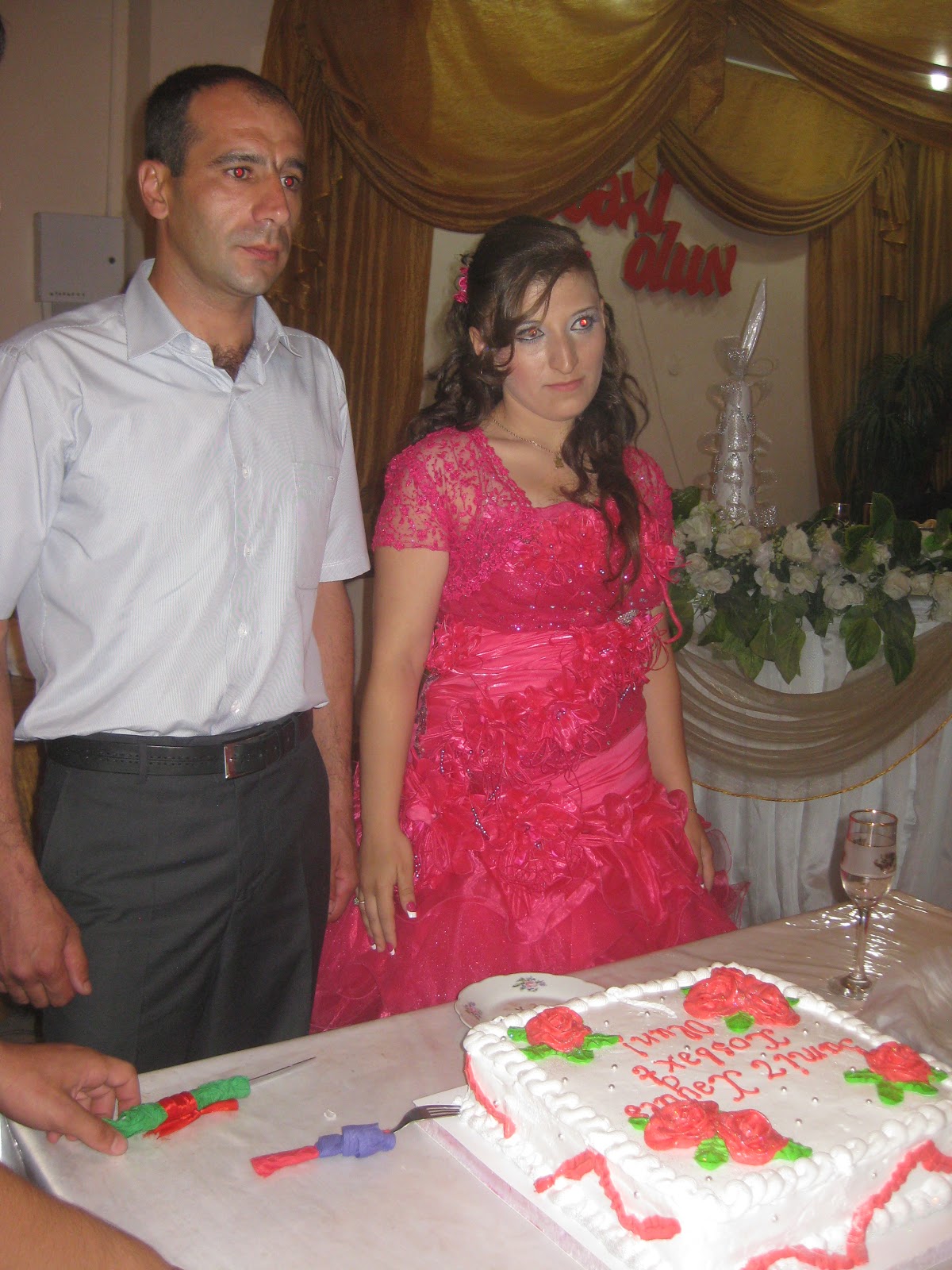
 The engaged couple preparing to receive the special box holding their engagement rings
 The small boxes inside contain the engagement  rings; the large box is also filled with fancily wrapped chocolates to "sweeten" the engagement, which are given then to guests at the engagement party.  Traditionally, the guests can take these wrapped chocolates home, place them under their pillow, and for ones who are unmarried dream about one's future suitor/spouse, not unlike the old-fashioned American custom of grooms-cake.

 The couple places the engagement rings on each others' finger (price-tags still attached),  connected with a red satin ribbon which will be ceremoniously cut

 Like all Azeri celebrations, an engagement party includes traditional Azeri dancing and music.  The engaged woman sometimes wears a colorful evening party gown to the engagement party.

In contrast, not all American couples have an “official” engagement party, in part because the couple decides for itself, independent of their respective parents, about marrying each other.  Nonetheless, my own Bon Voyage party before departing for Peace Corps service doubled as an opportunity to honor the engagement of my son Robby and his bride-to-be Audrey.  Several weeks prior to that, Robby "proposed" to Audrey, that is, he asked her to marry him, as he knelt on one knee—as is traditionally done--presented to her a small box holding an engagement ring, and ask  her:  “Will you marry me?”  This is the traditional way one becomes engaged, and is sometimes known colloquially as “popping the question”—the boy asking the girl to marry him.   (In Azerbaijan arranging to become engaged is sometimes known colloquially as having “the parents meet and talk.”)
The cake at our family and friends party was to celebrate my "bon voyage" into the Peace Corps and "congratulations" to Robby and Audrey on their engagement

I don’t think there is such a thing as an American-style bachelor party or bachelorette party in Azerbaijan.  From what I understand, traditionally, the groom is taken to a Turkish-style bath by his male friends…or maybe simply to the shower or bath at the home of one of his friends.  This is done the day before the wedding, in order to be clean and presentable to his bride, I assume.  The guys, I must assume, do have a good time, helping the groom prepare for married life.  In contrast, some time before an American wedding (and in Robby’s case the weekend before), but NEVER the day before, the groom is treated to a party by his “Best Man”—the one who officially witnesses and signs the legal marriage document—and his “Groomsmen” who assist at his wedding.  These are the groom’s family members and/or closest friends.  The bachelor party also is attended by other friends of the groom (all male), and usually they have fun going “out on the town” and celebrating.  For Robby’s party, the celebrations started in the back-yard pool, where everyone had a good time, and then the men left for several German restaurants (favorite places of Robby’s) near the University of Washington.
The traditional "bachelor party" -- with Robby, his brothers, and close friends

In Azerbaijan the day before the wedding, female family members and girlfriends gather with the bride-to-be in order to celebrate with tea and cakes, and often to decorate her hands with beautiful henna designs and the initials of the bride and groom.  These stay in place (and are not washed off) until the next day—the wedding day.  Again, in America, the typical bachelorette party would not take place the day before the wedding, but perhaps, as in Audrey’s case, the weekend before, the same day and time as Robby’s bachelor party.  The party is organized by the “Maid of Honor”—the one who officially witnesses and signs the legal marriage document—and her “Bridesmaids,” all female family members or closest of friends.  In Audrey’s case, she picked a very flashy dress to wear, was given a plastic crown and plastic ring with a huge fake, plastic “diamond,” and all the girls enjoyed celebrating at the apartment of one of her friends, before also going “out on the town.”
Audrey, ready for her "bachelorette party"
In America, the day before the wedding is the day of the rehearsal.  Since weddings in America follow a certain ceremony, with a procession of bridesmaids and groomsmen, sometimes flower girls and ring bearers, followed by the bride and her father, as well as vows to be said to each other, and often special music to be performed, everyone involved must know what to do and when to do it during the actual ceremony.  So this is practiced (rehearsed) the day before.  The rehearsal usually is late afternoon/early evening, the day before the wedding, followed by a big party for everyone involved; this party is called the Rehearsal Dinner.  Sometimes the Rehearsal Dinner is held in a family member’s home, sometimes in the banquet room of a restaurant, and usually all members of the Bridal Party attend.  The Bridal Party are those people who take part in the actual ceremony:  the Bride and Groom (obviously), their parents, the Best Man and Groomsmen, the Maid of Honor and Bridesmaids, the Flower Girl(s) and parents, the Ring Bearer(s) and parents, Readers, Officiant, sometimes special musicians, and in Robby’s and Audrey’s case, additional extended family members, so that this rehearsal dinner became like a family reunion.  Since Audrey is a descendent of one of the first settlers of Seattle, the Rehearsal Dinner was held at the original family home in the Highlands, now belonging to Audrey’s Uncle and Aunt, who so graciously hosted the fun evening and party.  That evening, after the Rehearsal Dinner, Audrey, her parents, the Maid of Honor, and all the Bridesmaids went to the Rainier Club in downtown Seattle, which was reserved for them to stay overnight, prepare the next morning for the wedding, and where, after the ceremony at church, the wedding dinner and dancing took place.  All the male members of the Wedding Party simply went to their respective homes after the Rehearsal Dinner.  Everyone in the Wedding Party gathered the next morning at the Rainer Club for the preparations—getting dressed into fancy tuxedo suits for the men, beautiful dresses for the Bridesmaids, and especially the bride.
 The day before the wedding, at the rehearsal (or practice) for the actual ceremony, which will take place the next day
 Soon-to-be married couple enjoying the Rehearsal Dinner at the home of her Aunt and Uncle in the Highlands
 
 Rainier Club, Seattle, where the Bride and Bridesmaids stayed the night before the wedding, the Bridal Party prepared the morning of the wedding, and where everyone gathered after the church wedding ceremony to celebrate with dinner and dancing.

In Azerbaijan, the preparations for the wedding are made at home; then at the home of the groom the Imam may come, bless the couple, and the official documents are signed.  The couple climbs into a car specially decorated with tulle and ribbons; close family members and friends also climb into their cars.  A procession of the cars, each blaring its horn, drives through town on the way to the banquet hall (wedding palace) where the invited guests are waiting the arrival of the couple.  The entire car procession and everything inside the hall is recorded on video for the excited couple to view at a later time.  The party at the wedding palace is often very large, sometimes 300-500 people; the traditional Azerbaijan foods are served, traditional music is played and everyone dances the traditional dances.  The various groups in attendance—families and relatives, school mates and colleagues, neighbors and associates—are expected to speak at the microphone and offer good wishes to the couple, who sit at a table on a small stage at one end of the hall.  Before one leaves the celebrations, it is anticipated that one will stop by the table set up to take donations for the couple; it is especially expected that one donate enough to cover the cost of the meal and attendance at the celebration and then extra for the couple.  This is lieu of giving gifts, which is more traditional in America, where the invited guests do not pay to attend the wedding.  The traditional gifts given at American weddings are part of the Azerbaijani bride’s dowry—things accumulated long before she ever becomes engaged or even knows who her groom will be, since the assumption is made in Azerbaijani society that all will eventually marry.  Sometimes there are two celebrations in Azerbaijan, if there are many friends and relatives…one for the bride’s side of the family, to which the bride will wear a colorful evening gown, and perhaps a week later, one for the groom’s side, at which the bride wears the traditional white wedding dress.  The groom’s wedding is considered the official wedding.

 Part of the wedding celebration involves the special presentation of one of the favorite Azerbaijani national dishes--plov, a type of rice pilaf--sometimes an elaborate entrance is made with waiter carrying torches and one specially selected waiter entering with the plov platter set aflame and dancing the traditional plov dance
 Plov dance
 One of many of the "wedding palaces" around town
 All Azerbaijani weddings involve dancing traditional dances to traditional music; frequently the bride wears a red sash to symbolize purity and virtue; white bands around her palms hold money that is gifted to her for her wedding; to show modesty, she frequently keeps her head bowed and eyes averted
 The bridal couple sits at a special table, slightly elevated, throughout most of the elaborate party celebration, but typically poses with all the various groups of invited guests
 Weddings are very important in Azerbaijani society, and also big business...the dresses often cost even more than typically in the States; the white dresses are for the official (or groom's) wedding; the colorful dresses are for the bride's wedding (prior to the groom's wedding), or for the official engagement party
 Weddings are so culturally important that numerous very popular TV shows are wedding shows, showing videos of people's weddings, or matching prospective couples, or showcasing weddings celebrated for a studio audience, as in this case, when two young people who are both orphaned and without immediate families met on a TV match-making show, became engaged on TV, and eventually married on this TV show
 Wedding cars elaborately decorated with tulle and ribbon carry the bridal couple to the 'wedding palace' for the wedding celebration

There are many types of weddings in America, some small and intimate, with only close family members present; some are just for the couple and take place at a courthouse or before a judge. Other popular venues are parks or beaches, where in nice weather the wedding can be celebrated outdoors.  America is a country of immigrants, and sometimes recent immigrants celebrate weddings according to the traditions of their homeland.  The traditional American wedding is often like Robby and Audrey’s in a church.  But no matter where the wedding is held, there are always the vows the couple makes to each other, which seals the marriage, and they usually exchange rings, which are then known as the "wedding rings"; married couples usually always wear their wedding rings on the fourth finger of the left hand, rarely ever removing them from their fingers.  (In Azerbaijan, daily wearing of wedding rings or wedding bands is not common, since the rings exchanged are usually engagement rings.)  Typically, the American couple leaves after the wedding on a trip together; this vacation trip is known as the "honeymoon."
The day of the wedding follows a very detailed schedule

The actual wedding ceremony usually follows a schedule and a definite routine
 The Ring Bearer and two Flower Girls are dressed and ready
 The Bride is ready and relaxing with her Maid of Honor and her Bridesmaids
 The Bride and everyone else is ready to leave for the church
 The Bride arrives by limousine with her Father and Bridesmaids at the church

The Bridesmaids, Groomsmen,  Flower Girls, Ring Bearer, and Bride and Father of the Bride are ready to enter the church in a special procession, called the 'wedding processional', and accompanied by special music
 In a procession the Bridesmaids and Groomsmen enter the church

 The Ring Bearer enters and carries the wedding rings
 The Flower Girls carry a garland of flowers
 Everyone stands as the Bride enters with her Father
 The Father lifts the bridal veil and presents his daughter to the Groom
 The Bridal Couple exchange vows (promises to each other) and exchange wedding rings
 The married couple is presented to the congregation, to all the invited guests
 At the party after the wedding ceremony there is music to enjoy as well as fine food
 The married couple has its own special dinner table
 The couple shares the wedding cake with each other
 The first dance is traditionally for just the Bridal Couple (the Bride and Groom)
 Then everyone dances
During the wedding ceremony the Bride and Groom exchange wedding rings that they then normally always wear as a reminder of their marriage vows to each other

In Azerbaijan, after all the festivities and dancing in the large banquet hall are over, the couple leaves for its new home; there is no custom of going on a honeymoon.  Occasionally a young man may have his own place; but more common the newly married couple moves in with the groom’s parents.  This affords the new bride an opportunity to learn from her mother-in-law the way to prepare meals her groom likes and other house-hold things necessary to care for her new husband.
 Another example of an Azerbaijani wedding banquet where a special plov dance is performed, a traditional dancer enters with a flaming plate of  plov (a special type of rice pilaf)
 Young and old dance the traditional dances

 Traditional Azeri music is performed
 The Azeri equivalent of Maid of Honor or Bridesmaid carries a special mirror, which stays on the dinner table by the couple throughout the celebration to bring good luck, and ward off bad
Everyone enjoys dancing (and some hi-jinks)

In Azerbaijan there are regional differences in how weddings are celebrated; in villages the celebrations might take place outdoors and last all day; in Baku the banquet halls (wedding palaces) may be especially large and opulent.

No matter where or how celebrated, weddings are an important part of the lives of Azerbaijanis and most Americans, and a fascinating glimpse into the cultural life of people around the world.

Saturday, August 11, 2012

The Good Samaritans


The Good Samaritans

After being back in the States for my son’s marvelous wedding to his wonderful new wife, I have returned refreshed to Azerbaijan for more Peace Corps work.  The time away has also allowed me to ponder a few of the wonderful and a few of the challenging aspects of Peace Corps work in Azerbaijan. 

Azerbaijan is a country rightly credited with outgoing hospitality towards guests, and this has certainly been true, as I have experienced it—an over-abundance of warmth and generosity.  For my July birthday, every group of students, colleagues, work-mates and associates honored me, as they basically do all the time…all my Azeri friends assure me, that no matter what I need, they are always willing to help me in any way they can.  I have helpful friends who respect and appreciate the efforts I make, and while I was gone in America, I missed my daily interactions with all of them.

But it is also noticeable that this hospitality, indeed respect, extends to the guests and individuals with whom one—Azeris included—has personal interactions.  It is equally true, that showing common courtesies to nameless people one might encounter on the street or elsewhere—well, that is a different matter.  Residents here have been known to throw garbage out their upper story windows onto the sidewalks below, and if a passing pedestrian is hit, it is a kind of “sport.” (Early on in living here, I was advised by some of my friends and associates to always walk away from the apartment buildings and close to the street curb, lest I be hit by garbage flying out of an upper story apartment window—and indeed once I could tell someone tried several times to drop eggs on me…oh, well…)  Don’t want to walk too close to the street either though, because again pedestrians are a kind of “sport” for men behind the wheel of a car…if a driver can swerve quickly toward you and then back again (without hitting you), it shows he has “great driving skill,” if not careless disregard for pedestrians.  Azeri friends recently returning from the States or Europe have remarked that one of the most notable and noticeable things for them is that, unlike Azerbaijan, pedestrians elsewhere have rights and respect, which is not afforded in this society where the more powerful (man behind the wheel) demands respect and greater rights than the less powerful (the lowly, nameless pedestrian).  Cars here never stop for pedestrians (it’s the other way around!), and in fact cars speed up and head straight for pedestrians who might be crossing the street, and honk at pedestrians to get out of their way.  Again, it is a kind of sport to see how fast they can drive, how close they can come to a pedestrian, without actually hitting him.  This lack of common courtesy is also evident in the mounting verbal harassment toward women on the street; and for female American Peace Corps Volunteers this particular lack of respect for women is an especially unpleasant challenge.

In thinking about these challenges and differences of societal values, I began pondering how Azeris would react to a nameless fellow human being, if that human being were in serious trouble.  Would the lack of common courtesies cause them to turn a blind eye (as happened once, when I witnessed a woman fall on the sidewalk and the young men standing near-by just gawked)?  Do Azeris have any societal concept akin to being a Good Samaritan?   And then it happened:

A day after returning from the States and an extended vacation in Berlin and Istanbul, my friend and fellow PCV Liz and I were traveling per marshrutka from my town to hers.  Soon after being on the road a ways, in a fairly rural area, our marshrutka driver quickly pulled over to the side of the road, let out an exclamation, rapidly halted our vehicle, and jumped out from behind the wheel of our marshrutka.  There, down an embankment about 5 feet lower than the road way, was an overturned car, wheels still spinning—the car must have jumped the road and flipped in mid-air, and the accident had apparently just happened.  But within less than a minute, all the men riding in the marshrutka were down the embankment helping the marshrutka driver offer aid to the injured—a man, bleeding, but sitting bewildered in the grass next to the car; a woman, face-down, unconscious and partially trapped under the vehicle; and a young boy, on the opposite side of the vehicle, lying limp and unconscious.  And immediately the passing cars from both directions stopped to offer help—pulling the woman away from the car, rousing her with some cool water, helping the young boy likewise, attempting to bandage the bleeding.  Everyone who could ran down the embankment to see what they could do to help.  Some were on their cell-phones.  But I credit the quick thinking of PCV Liz:  she had the foresight to call our very excellent Azeri Peace Corps Safety and Security Officer in Baku.  After explaining to him what had happened, that she and I were not involved in the accident, he asked to speak to the marshrutka driver.  The driver was able to explain to the Peace Corps Safety and Security Officer in Baku approximately where the accident occurred; then our Safety and Security Officer informed Liz that he would immediately notify the police in the nearest town.  In a country without a nationwide 911 emergency service, this was a huge service that Liz and the Peace Corps Safety and Security Officer did.  Soon a police car and an aid car did arrive from the nearby town.  But I cannot help but also credit all the drivers and passengers of no less than a dozen cars who stopped to offer assistance.  The out-pouring of help from this multitude of people to those strangers in very real need was truly amazing.  There were many, many Azeri Good Samaritans on the road that day!

Monday, July 9, 2012

Peace Corps Third Goal


All Peace Corps Volunteers are aware of the Three Goals of Peace Corps.

In 1961, President John F. Kennedy established the Peace Corps to promote world peace and friendship, with the following mission:

  • Helping the people of interested countries in meeting their need for trained men and women, by offering technical assistance to citizens of those countries where Peace Corps has been invited to serve.
  • Helping promote a better understanding of Americans on the part of the peoples served, by helping citizens of other countries improve their knowledge and awareness of America and Americans.
  • Helping promote a better understanding of other peoples on the part of Americans, by helping Americans learn more about the people and the culture of the countries in which Peace Corps is represented. 

Later this month, I am very pleased and proud to be participating in the Third Goal in Seattle, thanks to Kiwanis Club of Industrial Seattle and Division 26 of Kiwanis International.  And it will be a privilege to tell about the many wonderful experiences I have had so far as a Peace Corps Volunteer in Azerbaijan, at the crossroads of East and West.

Sunday, June 17, 2012

Home Sweet Home...and how to make perfect pancakes on an ancient gas stove...

Nothing like a WWII-era apartment that has seen little or no updating to be inspiration for  some creative redecorating.  With the help of friends and local PCV's, I used some lively print material (with traditional Azerbaijani paisley motif), which I have been able to drape over the most obvious of holes and unsightly flaws in the plaster of the kitchen--I was even able to use some colored duct-tape from the U.S.A. to decorate the exposed gas and water pipes.

But learning to adjust to the antique gas stove has been a challenge, as has been the recurring fluctuations in gas pressure.  In the late '60's and early '70's, I found it challenging to cook on the gas stove in our apartment in Munich.  But the even more antiqued stove I now use makes that one seem like the epitome of modernity.  And as in days of old, learning to make pancakes that are neither golden brown on the outside but raw on the inside, nor burnt on the outside but cooked through to the inside, has been an experiment in trial and error.  However, it has been great fun making them for Alex, et. al., and I think I might be (finally) getting the hang of cooking on a gas stove, or at least making pancakes on the gas stove.

BEFORE

AFTER


Friday, June 15, 2012

Tradition....Tradition....


Traditions….Traditions….

Living in Azerbaijan often reminds me of the musical "Fiddler on the Roof";  the role and importance of traditions are likewise very evident here, even among those of the younger generation for whom breaking with tradition might seem, on the one hand, desirable, but on the other, risky for maintaining family ties. 

And so it is that I have become aware of a common dilemma facing some young Azerbaijanis:  they fall in love!!  However, for some of these young people the decisions about their futures do not lie solely in their own hands.  I know several young couples who now must separate, because their parents have found different, more "suitable," mates for them—they cannot decide for themselves whom they should marry, it is decided by the parents.   Lucky is the young couple when the parents agree that the one they have chosen to love is also a suitable and agreeable choice for a marriage partner by the respective parents.  An engagement in fact is only really official when the respective parents meet, discuss, and decide that they will approve and allow an engagement to take place.  In this society going against your parents’ wishes, and certainly your parents’ decisions, could bring about a permanent rift—a disowning—and with that a forever tarnished reputation.  Of high value in Azerbaijan is the respect children, including adult children, show to their parents, and parents are likewise expected to make all important decisions for their adult children.  Unlike American families, where often parents begin training their children at an early age to make their own choices and eventually move out on their own, Azerbaijani children often follow the advice and decisions of their parents well into adulthood.  By tradition, a young married couple may even live in the home of the groom’s parents, so that the mother-in-law can show the new bride how to do things properly.  Some may not like this lack of freedom and lack of personal choice, but by tradition many Azerbaijanis do follow these societal norms.  For some modern-thinking Azerbaijanis these traditional ways can unfortunately lead to broken hearts; but alas, acceptance of tradition, even reluctant acceptance, is an important Azerbaijani value.   Moreover, unlike in America, where we might thumb our noses at what others think, here in Azerbaijan people are imbued with the notion that what others think of you—your reputation—is so very important, that one rarely risks the scoffing and scandal of breaking with tradition and going against the wishes of one’s parents.  However, Azerbaijan is also a country in transition, so the importance of some long-held traditions is weakening--at least for some Azerbaijanis.

It is not only in these arranged marriages where families decide what is best for an individual family member.  When I was making arrangements to move to my own apartment, the mother in my host family understood that it would be more convenient for me to live closer to my work; but she did not like the idea of me living on my own.  She told me, that if her house were closer to my work, she would ‘forbid’ me from moving to my own apartment, and that if I didn’t ‘obey’ she would call my daughter Christina in California and tell her to insist that I not move out on my own!  When I told Christina about this, she laughed, “Like as if I could have such influence and tell you what to do, Mom, eh?”  I replied, well here in Azerbaijan adult children do take care of and make decisions for their parents, but likewise, parents have final say over many important decisions in the lives of their adult children, too.  The American notion, “I’ll trust you to do what you feel is best,” is not the traditional family value espoused to here.

Lately, I have conducted sessions on American values and assumptions, based on writings from Gary Althen of the University of Iowa.  It is just as eye-opening for me as an American to realize why we Americans view things in certain ways—why for us individualism, independence, and freedom are so highly valued.   It is equally important and interesting to catch a glimpse of why, for much of the rest of the world, such typical American values carry less weight and less importance.  Whereas Americans believe in a can-do attitude and a desire to instill change, many others in the world take a fatalistic and complacent view of life—what will be, will be.

 Last week, we had a wonderful outing organized by a youth organization here in Mingachevir; now that the university semester is over, a crowded bus-ride full of young people into the mountains was in order, though at first it seemed it may not happen when the promised bus-driver slept in and didn’t show up; but after an hour of searching, a new bus driver was found.  Once we got started, we knew we were in for quite a ride...the mini-bus was over-packed and some of the guys sat in the aisle on the floor or on little crates, even a small park-bench was brought into the bus, but alas, some guys still had to stand the whole trip.  After an hour over rural mountain roads, we settled into a picnic shelter, barbequed kebabs of lamb and chicken as well as potatoes, onions, peppers and tomatoes.  It was great.  Also, there was an invigorating (very steep) hike to the ruins of an old fortress castle and a rousing game of mafia.  The whole day was funny and fun!

Over-crowded mini-bus

Will our bus fit under the road barrier?
Road to our destination
Picnic prep
Samovar tea

Kebab sandwich...tis good
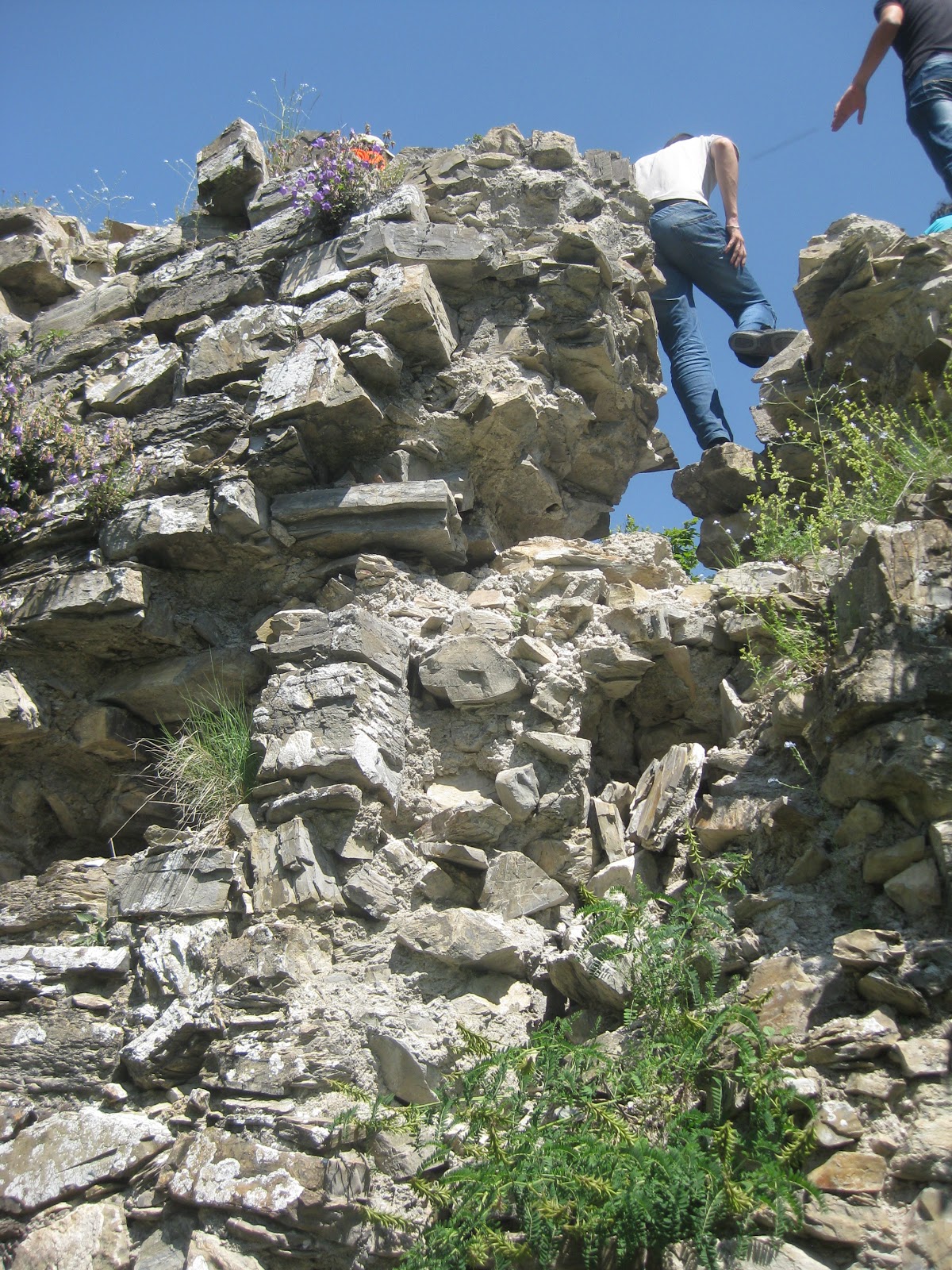
Medieval fortress...now in ruins


Scaling the ramparts of the ruins


The mighty Caucasus with view to Russia


Skewered kababs for barbequing


Friday, June 1, 2012

Eurovision Song Contest...Light Your Fire...and the Winner is...


Eurovision Song Contest…Light Your Fire...and the winner is…..

Every year, the Eurovision Song Contest is broadcast by the European Broadcasting Union all over Europe.  Each country submits an original song to be performed by an artist or artists from the respective country.  A jury of specialists, like American Idol, rates the songs to be sent on to the Grand Finale, which then is voted on by viewers all over Europe, and as far away as Azerbaijan.  Each year the huge television production is held in the country of the previous year’s winner.  And so it was, with great pride after winning the 2011 Eurovision Song Contest, that Azerbaijan, known as the Land of Fire, hosted this year’s competition last weekend, with the theme and motto--Light Your Fire.  An elaborate new hall—the crystal hall palace in Baku—was built just for this event.  This Eurovision television spectacular was already a big event during the years that Bill and I lived in Germany in the 1960’s and 1970’s, and I remember well watching the shows every year to see which country would win—it brings pride and jubilation to the winning country, and after winning last year’s competition, throngs stormed the streets of Baku celebrating, as though they had just won the World Cup!

Because it must be shown during prime time in Europe, the semi-finals and the Grand Finale couldn’t start until midnight local time here in Azerbaijan.  But watch we must!  And so we had our own little PCV viewing party at the home of good friend of all Peace Corps Volunteers, Gulnaz.

Some chose to boycott the Song Contest in Azerbaijan, and others used the event to point out political issues that plague Azerbaijan’s reputation on the world stage.  Armenia, with a decades-long dispute over contested territory which they now occupy and on-going war with Azerbaijan, did not send an entry nor attend.  Other human rights organizations hoped to draw attention to the civil and human rights violations of a country known for imprisoning hundreds of journalists who oppose government policies and a country accused by others of corruption throughout many facets of society.  On international rankings of corruption and human rights violations, Azerbaijan scores poorly relative to the rest of the world, and especially relative to the rest of Europe.  Moreover, located in a strategically important part of the world, Azerbaijan reportedly thwarted numerous terrorists plots, which were designed to disrupt the Eurovision events.

But none of that seemed to dampen this year’s celebration which turned out to be quite a Baku party.  The city polished up its attractive and historic core, and put on the glitz and glamour that would rival any pop-culture show anywhere in the world.  And the winner—and host of next year’s competition…Sweden!  But I must admit, my favorites, the ones that I was rooting for, were—the pleasant German entry, the local favorite—Azerbaijan, the singing babushkas from Russia (came in 2nd place), and the fancy feet of the group from Malta…ah, well…

Have a view:


 Don't miss the singing Babuskas enticing everyone with "Party for Everybody":