Thursday, May 9, 2013

Going 'guesting' and sight-seeing

Guesting...and sight-seeing...in Azerbaijan

Among the Azerbaijani traditions which are lots of fun and enjoyable are the 'guesting' experiences--visiting people in their homes.  It is best to be prepared to be feasted...

So, soon after Christina arrived in Azerbaijan, and after we exhausted the town's Novruz celebrations, we toured the back streets of Mingachevir.  And went 'guesting'.

Christina with Masazir host family

Baskets for sale on the street for engagement celebrations

Shopping for a cow's head, which when added to hooves makes for  a typical stew dish  called  Xaş

Playing tic-tac-toe


Christina with Mingachevir host family...

...and Babek's family

Soon we departed by marshrutka over bumpy roads, sometimes clogged with sheep and cattle, for the grand sights of Azerbaijan in Sheki and Baku...


...view of the road out the window of the marshrutka.


First stop in Sheki--another school
and then the fine views of the ancient Alban church in Kish, near Sheki
 oldest church in the Caucasus

 Toured around with friends Liz and Kathy...and then on to the fabulous palace of the Khan...


Relaxing with Kathy and Liz in Sheki, which also was preparing for more Novruz celebrations--bonfire preparations.


On the grounds of the ancient Silk Road Karavansaray, caravan resting stop


Sheki streets decorated for Novruz


On to Baku via the Caucasus mountain road...


 In Baku.........One of the world's largest, if not THE largest flag pole and plaza with the Crystal Palace to the left, the showplace of the 2012 Eurovision Song Contest...


and Christina warming up to get in tune, just in case they ask her to also perform...

The flame tower buildings and martyrs' lane (solemn resting place of martyred heroes of uprising against Soviet tanks at the time of the break-up of the Soviet Union and the declaration of Azerbaijan as an independent nation).


Flame towers and mosque...tradition and modernity merge...

 Museum of the National Poets...


and the typical Old Town restaurant

The Altstadt Hotel--decorated with European (including Bayern Munich) football regalia.


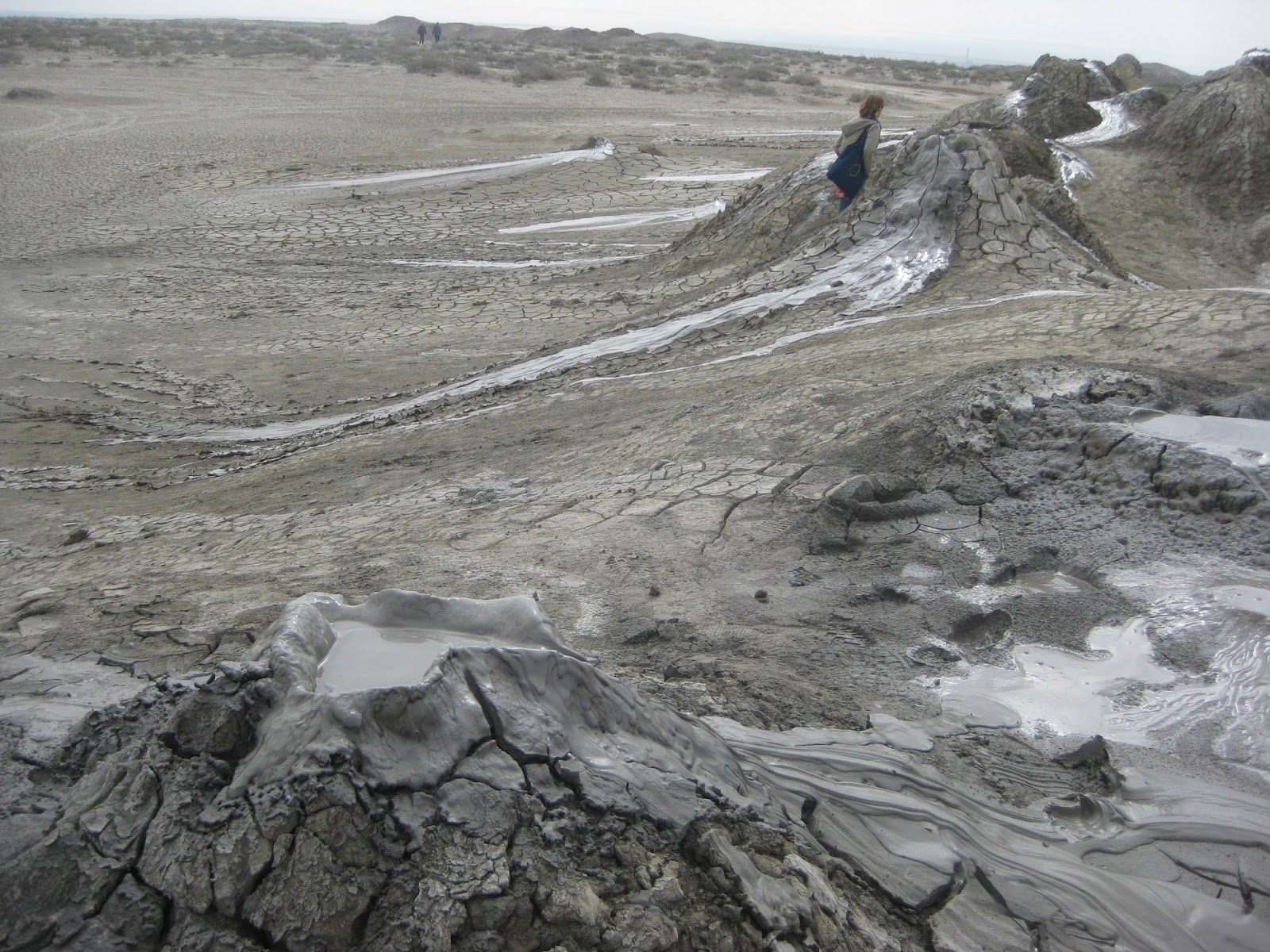
And furnished a driver to take us and fellow PCV friends on a trip to the mud volcanoes...


And the fascinating museum and ancient petroglyphs of Qobustan...

Hunters, deer, and a carving of an ancient Viking ship...indicating a prehistoric Norse-Azerbaijani connection

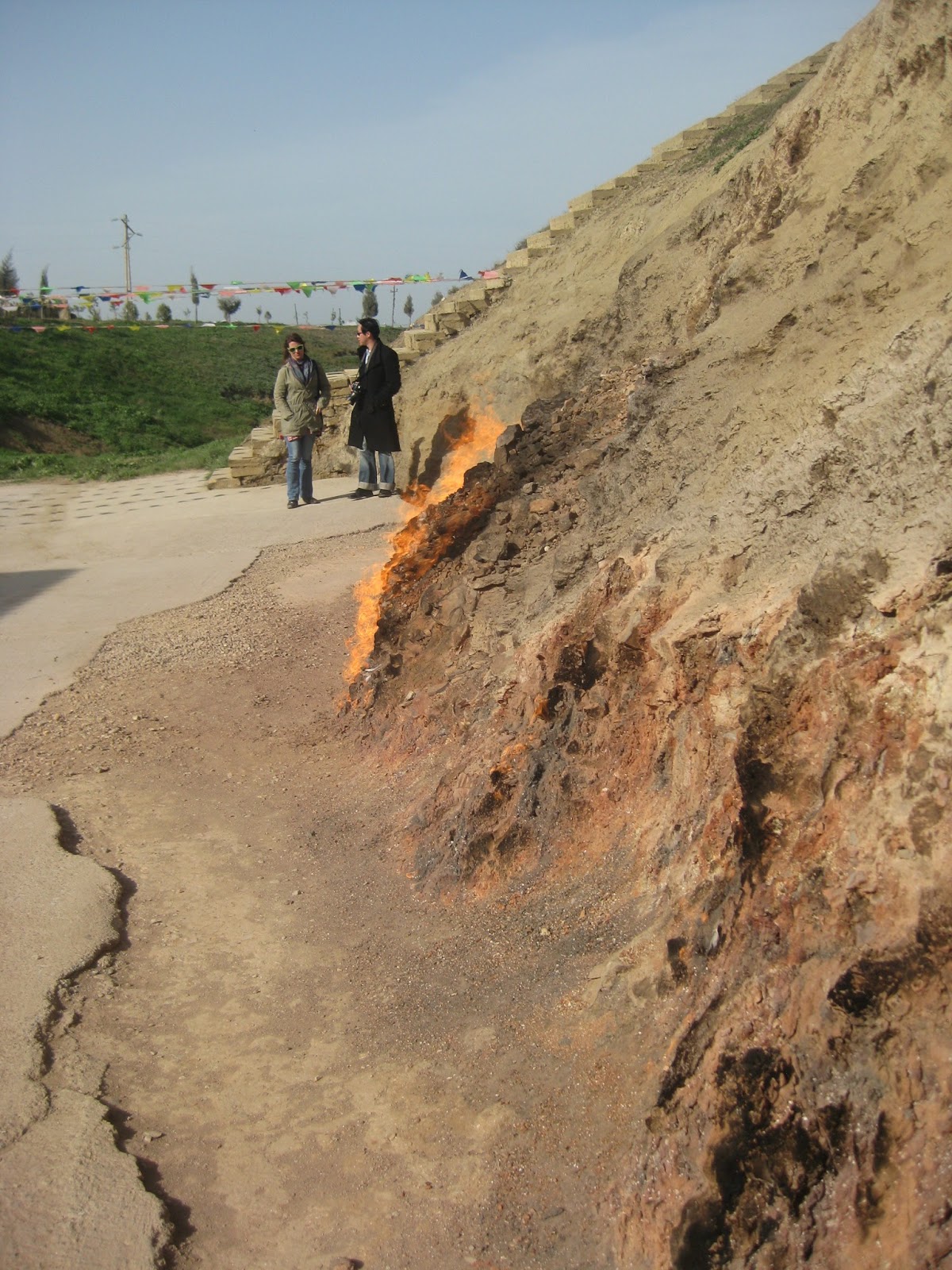
We stopped at the fire mountain, where the hillside is literally on fire, continuously burning since ancient times

The famous Baku oil fields which made the Nobel brothers wealthy, and able to sponsor in perpetuity noteworthy prizes, and which were featured in the movie "The World is not Enough" from which James Bond as usual miraculously escapes a fiery doom 


The ancient fire temple, important since ancient times, for the Zoroastrians and Hindu mystics

In Qala we visited ancient and newly excavated archaeological village buildings
Carpet weaving--a traditional craft... as is pottery making...


In the so-called marriage house, Christina poses...


and later makes friends with the camels.


 Baku boasts the largest KFC restaurant in the world


Posing under the sign for the Nərd House, the one who has earned the family nick-name, Nerdstina

More famous Baku sights...McDonald's and


the Palace of the Khan

 Walking down a typical street in Old Town Baku, on our way to another special guesting experience...


Bye to Baku...

Time to bid farewell to Baku, on the shores of the Caspian Sea...

Wednesday, May 8, 2013

New Rules... (for visitors to Azerbaijan)


I was fortunate enough to have hosted special guest and family member (daughter Christina) for the Novruz Holiday.  Turns out, she came just in the nick of time to avoid the new hassle for foreign visitors, as it was explained via the U.S. Embassy:

The U.S. Embassy in Baku, would like to inform all U.S. citizens residing in Azerbaijan that on April 1, 2013 the State Migration Service of Azerbaijan enacted a new law on the registration of foreigners. 
The new regulations require that all foreigners register with the State Migration Service within three days of arriving in Azerbaijan.  The registration requirement previously applied only to visitors who intended to stay in Azerbaijan for at least 30 days. 

Last summer, when I had to renew my registration for remaining in Azerbaijan, the whole thing took hours at the local police station, and lasted over a week's time.  But since my daughter's tourist time in Azerbaijan was less than a week, it is a good thing we were not so encumbered.  

Our quick Azerbaijan tour was fabulous, but the main event was experiencing the Azerbaijani festival celebrating the arrival of spring, called Novruz, celebrated on March 21-22, the first of Spring: 


Her middle of the night flight from Istanbul set her down in Gence, an hour by taxi from Mingachevir, and thanks to the help of Babek, we picked her up bright and early and headed to my home.  From there we set out to explore the sights of the town and ended the day celebrating with good friend and neighbor Gulnaz, who prepared the typical holiday foods, and with the entire neighborhood we jumped the bonfires and visited    neighbors.


Christina at the Sea of Mingachevir, Caucasus Mts. beyond

Admiring Mingachevir's "Space Needle"

On banks of Kur River by the "Space Needle"

Christina visits a class... 

...and admires the students' presentation


Bonfires being built in school yards...

...and in the neighborhoods, preparing for the bonfire jumping...

But first we prepare to enjoy Novruz feast...

...which includes the national dish--plov...

...a very special rice pilaf with dried  fruits and meats

Everyone gets ready for the bonfire jumping...

...all participate, even the youngest Azeris

Christina, too, participated in bonfire jumping.  Jump 3 times and symbolically cast your troubles away into the fire.

The day after the bonfire jumping, the whole town celebrates with displays, dancers in national costume, tight-rope walkers, athletic performances, traditional music..


A map of Azerbaijan is filled in with typical holiday sweets, dried fruits and nuts


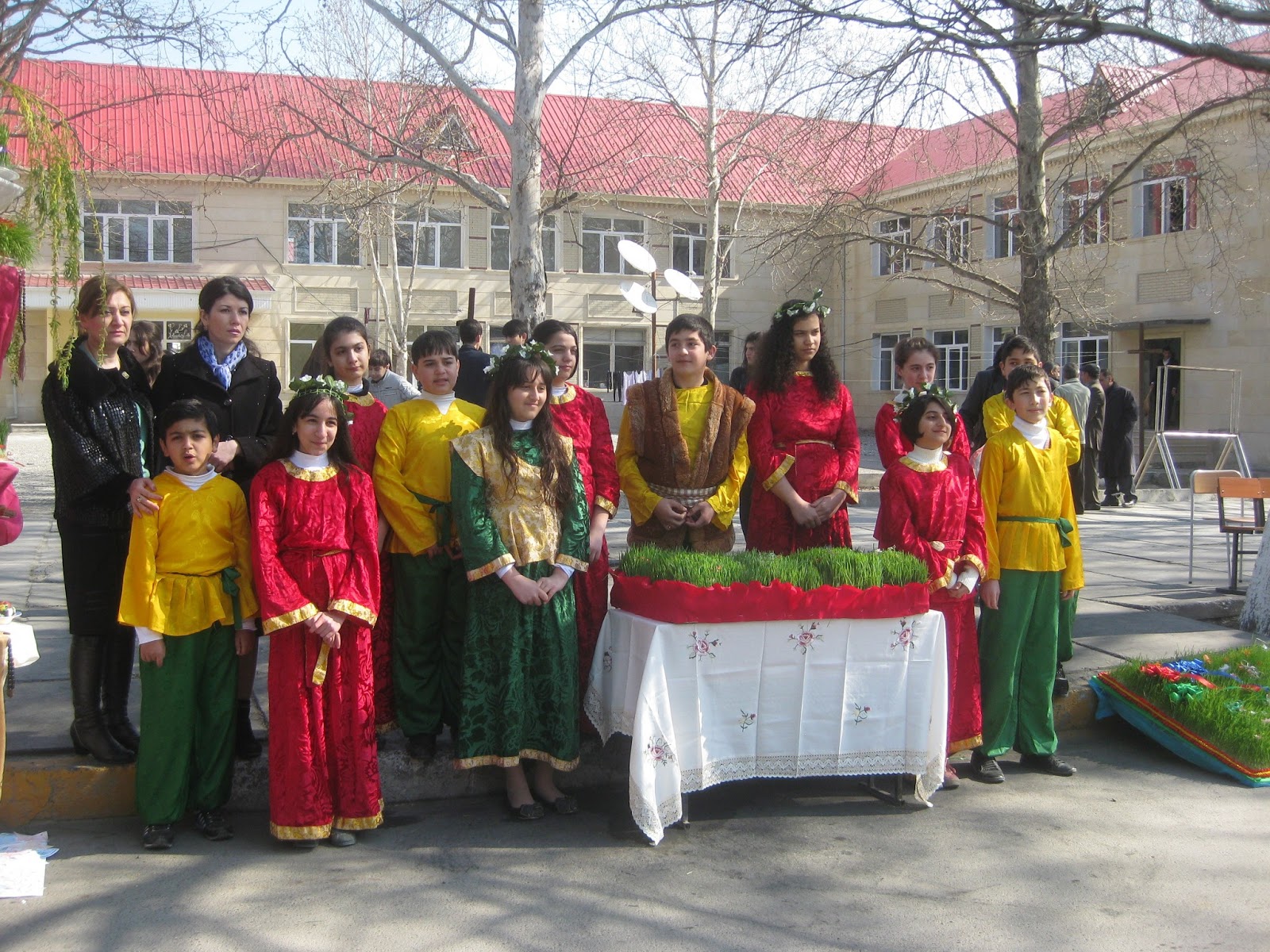
Schools hold celebrations with traditional music, dancing, costumes


Novruz--a happy national celebration of Spring


Friday, May 3, 2013

Life is Calling. How Far Will You Go? - Peace Corps


How far would one go to help someone in need? 12,000 miles? For how long? 2+ years? To share knowledge and expertise? And learn much in return? Peace Corps--fabulous and worthwhile in many respects. :)
View the link:
http://youtu.be/EqOH2M12VUg

Saturday, April 27, 2013

The Worthwhile Things in Life...for one, work that is appreciated!

Ah...the life of a PCV--the work is more than just a little challenging, the living conditions are *different*, but when the people you serve and work with shower you with their homemade, delicious food, and gifts, and glowing words of appreciation, begging you to stay and never leave...well, that certainly makes it one of the most worthwhile things in life!

Friday, April 12, 2013

40 Days of Mourning


40 Days of Mourning

Several weeks ago, we celebrated the 40th day of my neighbor’s passing.  In accordance with custom here, every Thursday following a death, family and friends gather for memorial celebrations, but the most eventful is the gathering on the 40th day.  The widower specifically asked that my neighbor and friend, Gulnaz, and I attend.  

Following our early morning classes, we went to his apartment a little after ten a.m.  There in a circle, sitting on the floor on cushions (most of the furniture had been removed to accommodate the floor cushions), were a dozen or so female family members, relatives, and neighbors, modestly covering their feet and legs with sheets.  Even the wall mirror was covered with a sheet, so that the female mourners would not be distracted from the seriousness of the mourning process by admiring themselves—or so it was explained to me.  The males waited and milled around outside the apartment building.  Soon we were called to leave, and several taxis were waiting outside to transport us to the cemetery.  Immediately after death, the body is buried, but only men attend the actual burial service, women remain at home to mourn.  So this day was the first day women could go to the cemetery, now that the grave stone was completed and in place.
 
Female mourners gather inside the apartment (2nd floor, first stairwell in the back) both before and after the ceremonies at the cemetery
At the cemetery, the women gathered around the grave-stone monument, while the men stood in the background.  Soon the closest female relatives—the daughters-in-law—wiped and kissed the etched image of the deceased on the upright grave stone and began to chant and wail.  Soon all the women took out handkerchiefs, held them to their mouths, and likewise began to mumble and cry.  The moaning and wailing continued to a fevered pitch, as it is considered proper and expected for all the women present to physically shed tears, cry and show emotion; the men stoically, however, continued to mill around in the background (some quietly chatting with each other and smoking cigarettes), while the women finished extolling the virtues of the deceased through their chanting about how wonderful she was as a mother, wife, neighbor, and friend.  When the moaning and wailing on the part of the women subsided, the molla and his assistant from the near-by mosque stepped forward to the head-stone, and the men, too, gathered round.  In chanting fashion, the molla sang the appropriate verses from the Qoran.  Eventually, all returned to the waiting taxis, and went back to the apartment building.
Grave headstones frequently have etched portraits


Sometimes the headstones have full-bodied etched images
Frequently red ribbons are wrapped around the headstones

There are very few fresh flower shops and most people do not have flower gardens, so artificial flowers are the most common


Back at our apartment building, the male mourners began to assemble in the event tent outside, while the women once again gathered inside the apartment, sat on cushions around the room, covered themselves with the sheets, and participated in the female molla-led crying, shedding of tears, and chanting.  This continued for about an hour, and as more arrived, we left to make room and went to the event tent.  There waiting for us and all the other mourners was the feast of mourning, complete with national foods of plov (rice) and beef stew.  Many people are expected for the 40th Day of Mourning, just like the actual funeral itself, so it is expected that those in attendance pay for their meal.  A record is kept of who paid, and how much (much like at wedding celebrations, too).  It is basically on the honor system, but since it is such an important part of tradition here, everyone complies as is expected.
 
For the actual funeral meals, portable event tents are erected, but for the 40th Day of Mourning  meal, the more permanent "tent" is used.  This is actually a long, low building with corrugated metal roof located near a group of apartment buildings--ours is directly behind this structure.  Behind the first door is a small kitchen (sink is outside, between the doors) and the second door opens to the eating hall with two rows of long tables, separated by a curtain.  Men sit at the first row of tables, and behind the curtain the women mourners sit at the second row of tables.   For the funeral itself there were two separate tents, one for men, one for women.  
I learned that it is customary for family members to return to the graveside of the deceased every Thursday for years to come.  This way the deceased’s memory and legacy is continually honored.  Personally, I find this a very respectful, honorable tradition.  In our society, as I have heard it expressed among family and relatives, once someone has died, the comment can be made:  he/she is no longer with us, so now we can do as we wish.  This attitude would be considered so disrespectful here, that making such a comment would be considered despicable.  In this culture here in Azerbaijan, abiding by the hopes and wishes of the deceased allows the family and relatives to stay united in honoring family legacies.  It may not have the binding of a legal document, as would be required in our society, but it definitely holds the fabric of this society together and in tact—the family.

Saturday, April 6, 2013

Cost of Living

Every Peace Corps Volunteer is given a modest allowance to match the average cost of living in the developing country in which one serves.  Recently, we were given a survey to list the cost of normal items found here in Azerbaijan, and which we all need.  Suffice it to say, with some exceptions, it costs a lot to live in Azerbaijan.  Food, for one thing, is very expensive, and meat in particular is quite prohibitive.  I get most of my protein intake from eggs (cost about the same as at home), cheese (more expensive), and rice and beans (about the same).  Vegetables in season can be less expensive, and the ubiquitous "greens" (herbs) in the open-air markets are also reasonable.  Bread, a dietary staple and even considered "sacred," is reasonable--you never throw away stale bread, because of its sacred nature, rather it is placed on a fence, a ledge, or some other open space, to be found and consumed by a bird or roaming animal. 

But when one considers that the average salary of a school teacher or a doctor (state employees) is about $150-$300 per month, the cost of food seems very high.  Indeed, a recent survey found that the cost of food  relative to income in Azerbaijan was the highest in the world.  http://saynotofoodwaste.org/2013/04/01/spending-all-the-money-on-food/


Clothing also can be quite expensive, and often the imports from China seem to be seconds, but at full cost or even more.  The high-end fashion boutique shops in glitzy parts of Baku seem to be only for show, since they are always empty; average citizens could never afford to shop there.

But the high cost of food seems so unnecessary.  Azerbaijan is a country with nine distinct climates, able to produce delicious (albeit seasonal) fruits and vegetables, and shepherd large flocks of sheep and cattle.  Unfortunately, enjoying this bounty consumes a large part of the average Azeri's income.