Sunday, June 17, 2012

Home Sweet Home...and how to make perfect pancakes on an ancient gas stove...

Nothing like a WWII-era apartment that has seen little or no updating to be inspiration for  some creative redecorating.  With the help of friends and local PCV's, I used some lively print material (with traditional Azerbaijani paisley motif), which I have been able to drape over the most obvious of holes and unsightly flaws in the plaster of the kitchen--I was even able to use some colored duct-tape from the U.S.A. to decorate the exposed gas and water pipes.

But learning to adjust to the antique gas stove has been a challenge, as has been the recurring fluctuations in gas pressure.  In the late '60's and early '70's, I found it challenging to cook on the gas stove in our apartment in Munich.  But the even more antiqued stove I now use makes that one seem like the epitome of modernity.  And as in days of old, learning to make pancakes that are neither golden brown on the outside but raw on the inside, nor burnt on the outside but cooked through to the inside, has been an experiment in trial and error.  However, it has been great fun making them for Alex, et. al., and I think I might be (finally) getting the hang of cooking on a gas stove, or at least making pancakes on the gas stove.

BEFORE

AFTER


Friday, June 15, 2012

Tradition....Tradition....


Traditions….Traditions….

Living in Azerbaijan often reminds me of the musical "Fiddler on the Roof";  the role and importance of traditions are likewise very evident here, even among those of the younger generation for whom breaking with tradition might seem, on the one hand, desirable, but on the other, risky for maintaining family ties. 

And so it is that I have become aware of a common dilemma facing some young Azerbaijanis:  they fall in love!!  However, for some of these young people the decisions about their futures do not lie solely in their own hands.  I know several young couples who now must separate, because their parents have found different, more "suitable," mates for them—they cannot decide for themselves whom they should marry, it is decided by the parents.   Lucky is the young couple when the parents agree that the one they have chosen to love is also a suitable and agreeable choice for a marriage partner by the respective parents.  An engagement in fact is only really official when the respective parents meet, discuss, and decide that they will approve and allow an engagement to take place.  In this society going against your parents’ wishes, and certainly your parents’ decisions, could bring about a permanent rift—a disowning—and with that a forever tarnished reputation.  Of high value in Azerbaijan is the respect children, including adult children, show to their parents, and parents are likewise expected to make all important decisions for their adult children.  Unlike American families, where often parents begin training their children at an early age to make their own choices and eventually move out on their own, Azerbaijani children often follow the advice and decisions of their parents well into adulthood.  By tradition, a young married couple may even live in the home of the groom’s parents, so that the mother-in-law can show the new bride how to do things properly.  Some may not like this lack of freedom and lack of personal choice, but by tradition many Azerbaijanis do follow these societal norms.  For some modern-thinking Azerbaijanis these traditional ways can unfortunately lead to broken hearts; but alas, acceptance of tradition, even reluctant acceptance, is an important Azerbaijani value.   Moreover, unlike in America, where we might thumb our noses at what others think, here in Azerbaijan people are imbued with the notion that what others think of you—your reputation—is so very important, that one rarely risks the scoffing and scandal of breaking with tradition and going against the wishes of one’s parents.  However, Azerbaijan is also a country in transition, so the importance of some long-held traditions is weakening--at least for some Azerbaijanis.

It is not only in these arranged marriages where families decide what is best for an individual family member.  When I was making arrangements to move to my own apartment, the mother in my host family understood that it would be more convenient for me to live closer to my work; but she did not like the idea of me living on my own.  She told me, that if her house were closer to my work, she would ‘forbid’ me from moving to my own apartment, and that if I didn’t ‘obey’ she would call my daughter Christina in California and tell her to insist that I not move out on my own!  When I told Christina about this, she laughed, “Like as if I could have such influence and tell you what to do, Mom, eh?”  I replied, well here in Azerbaijan adult children do take care of and make decisions for their parents, but likewise, parents have final say over many important decisions in the lives of their adult children, too.  The American notion, “I’ll trust you to do what you feel is best,” is not the traditional family value espoused to here.

Lately, I have conducted sessions on American values and assumptions, based on writings from Gary Althen of the University of Iowa.  It is just as eye-opening for me as an American to realize why we Americans view things in certain ways—why for us individualism, independence, and freedom are so highly valued.   It is equally important and interesting to catch a glimpse of why, for much of the rest of the world, such typical American values carry less weight and less importance.  Whereas Americans believe in a can-do attitude and a desire to instill change, many others in the world take a fatalistic and complacent view of life—what will be, will be.

 Last week, we had a wonderful outing organized by a youth organization here in Mingachevir; now that the university semester is over, a crowded bus-ride full of young people into the mountains was in order, though at first it seemed it may not happen when the promised bus-driver slept in and didn’t show up; but after an hour of searching, a new bus driver was found.  Once we got started, we knew we were in for quite a ride...the mini-bus was over-packed and some of the guys sat in the aisle on the floor or on little crates, even a small park-bench was brought into the bus, but alas, some guys still had to stand the whole trip.  After an hour over rural mountain roads, we settled into a picnic shelter, barbequed kebabs of lamb and chicken as well as potatoes, onions, peppers and tomatoes.  It was great.  Also, there was an invigorating (very steep) hike to the ruins of an old fortress castle and a rousing game of mafia.  The whole day was funny and fun!

Over-crowded mini-bus

Will our bus fit under the road barrier?
Road to our destination
Picnic prep
Samovar tea

Kebab sandwich...tis good
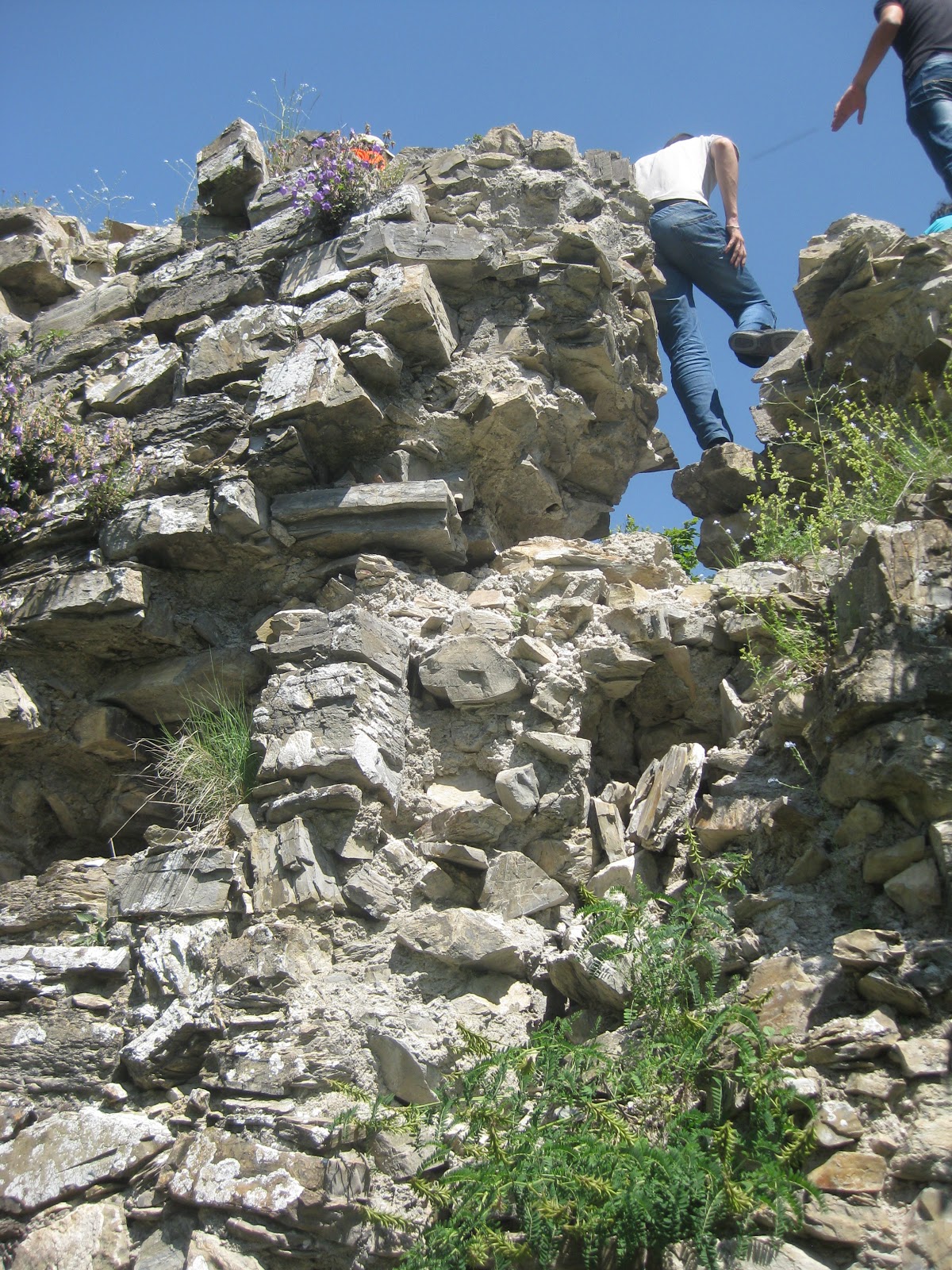
Medieval fortress...now in ruins


Scaling the ramparts of the ruins


The mighty Caucasus with view to Russia


Skewered kababs for barbequing


Friday, June 1, 2012

Eurovision Song Contest...Light Your Fire...and the Winner is...


Eurovision Song Contest…Light Your Fire...and the winner is…..

Every year, the Eurovision Song Contest is broadcast by the European Broadcasting Union all over Europe.  Each country submits an original song to be performed by an artist or artists from the respective country.  A jury of specialists, like American Idol, rates the songs to be sent on to the Grand Finale, which then is voted on by viewers all over Europe, and as far away as Azerbaijan.  Each year the huge television production is held in the country of the previous year’s winner.  And so it was, with great pride after winning the 2011 Eurovision Song Contest, that Azerbaijan, known as the Land of Fire, hosted this year’s competition last weekend, with the theme and motto--Light Your Fire.  An elaborate new hall—the crystal hall palace in Baku—was built just for this event.  This Eurovision television spectacular was already a big event during the years that Bill and I lived in Germany in the 1960’s and 1970’s, and I remember well watching the shows every year to see which country would win—it brings pride and jubilation to the winning country, and after winning last year’s competition, throngs stormed the streets of Baku celebrating, as though they had just won the World Cup!

Because it must be shown during prime time in Europe, the semi-finals and the Grand Finale couldn’t start until midnight local time here in Azerbaijan.  But watch we must!  And so we had our own little PCV viewing party at the home of good friend of all Peace Corps Volunteers, Gulnaz.

Some chose to boycott the Song Contest in Azerbaijan, and others used the event to point out political issues that plague Azerbaijan’s reputation on the world stage.  Armenia, with a decades-long dispute over contested territory which they now occupy and on-going war with Azerbaijan, did not send an entry nor attend.  Other human rights organizations hoped to draw attention to the civil and human rights violations of a country known for imprisoning hundreds of journalists who oppose government policies and a country accused by others of corruption throughout many facets of society.  On international rankings of corruption and human rights violations, Azerbaijan scores poorly relative to the rest of the world, and especially relative to the rest of Europe.  Moreover, located in a strategically important part of the world, Azerbaijan reportedly thwarted numerous terrorists plots, which were designed to disrupt the Eurovision events.

But none of that seemed to dampen this year’s celebration which turned out to be quite a Baku party.  The city polished up its attractive and historic core, and put on the glitz and glamour that would rival any pop-culture show anywhere in the world.  And the winner—and host of next year’s competition…Sweden!  But I must admit, my favorites, the ones that I was rooting for, were—the pleasant German entry, the local favorite—Azerbaijan, the singing babushkas from Russia (came in 2nd place), and the fancy feet of the group from Malta…ah, well…

Have a view:


 Don't miss the singing Babuskas enticing everyone with "Party for Everybody":


Monday, May 28, 2012

Kiçik Toy


The Kichick Toy (the small wedding)

Last week I went to what will surely be my one-and-only kichick toy, or little wedding.  Given the demographics of the people I know, my friends and associates, it’s not too likely I will be invited to another, let alone even know anyone else who will be celebrating a kickick toy.  You see, a ‘little wedding’ as it is known here is not at all about a couple marrying.  Instead, it is the celebration of a young boy’s coming of age…his ritual circumcision.  Sometime before the onset of adolescence, Azeri boys are honored with a party, celebration, and gifts, known as the kichick toy, the small wedding, in preparation for his circumcision.  It can involve a party in the home with family and friends, or a very large celebration in one of the special restaurants, known as ‘celebration or wedding palaces,’ designed to elaborately serve huge receptions for such occasions.  In honor of my host family’s son, Ibrahim, now eight years-old, a large reception, with at least two-hundred fifty family, friends, and colleagues and associates of the parents in attendance, was held for him last Sunday at a beautiful ‘wedding palace’ restaurant.
 Playing in the courtyard, while adults get ready
 Even the neighborhood geese sense something is up
 Arriving at the family home for the big event
 Big sister poses
 Ibrahim gets last minute attention to his attire

First of all, the family members gathered at the family home, and being considered one of the family, I arrived several hours before the actual celebration was to begin at the wedding palace.  There I met some of the relatives I already knew and met about fifty more!  Some, like the grandfather and great-uncles of Ibrahim, came from Moscow and Russia to be in attendance.   (With huge unemployment among males in the regions outside of Baku, many male family members work in Russia to support their families back home in Azerbaijan.)   The house and garden was bustling with relatives scurrying about to  get ready for the celebration…clothes were being pressed, last minute adjustments to hair-dos and make-up, and finally all the relatives were ready for the procession to the wedding palace.  But first some musicians arrived and in the patio area of the house, they struck up some familiar Azerbaijani music on traditional instruments, with sounds that are distinctively Middle Eastern.  Soon dozens of family members, including little Ibrahim, were dancing the traditional Azeri dances in the patio.  Then it was time to leave for the wedding palace.
 Musicians in the courtyard of the family home provide a little pre-function festivities for the family and relatives
 Warm-up dancing in the courtyard to typical Azeri music
 Ibrahim and his attendant lead the Azeri dancing
 
Everyone piled into various cars for the short ride to the wedding palace.  Ibrahim, of course, was in the lead car, together with his attendants—two friends and his nine year-old sister.  The car was decorated like a wedding car, with red and white tulle streamers and bows on it.  It was driven down the middle of the road, horn blaring, followed by my car and all the other cars with family and relatives, each also honking horns.  When we arrived at the wedding palace, we all went inside to find seats at tables still available, since all the other two hundred or so guests were sitting at tables waiting.  Once everyone was seated, just like at a marriage wedding, Ibrahim and his attendants made a grand entrance up through the center of the room to the specially decorated table on a small stage in front of the large reception hall, reserved especially for the one(s) being honored.  Opposite was the stage for the musicians, who were already playing (very loudly!) the typical Azerbaijani music.
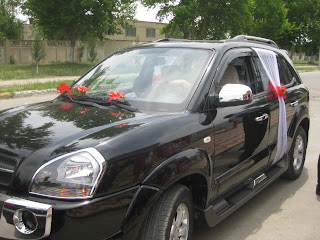
 The wedding car
 Ibrahim wishes he could drive it himself
 The wedding palace
 Ibrahim and his attendants sit at special table on stage at front of the hall
 The musicians perform typical Azeri music, and inordinately loudly, so that at least one little girl and old woman at my table both had to stuff napkins in their ears to soften the volume of the music
 Proud family
Soon the many waiters came out carrying the first courses of the elaborate feast.  As with any wedding palace celebration, the meal always consists of “national dishes,” served in specific order.  To begin with, the national salads—Capital Salad and Mimosa Salad, which are variations of potato and cooked vegetable salad in mayonnaise dressing, similar to Russian Salad--along with condiments of pickles, olives, and pickled cabbage are on the table, as well as fresh tomatoes and cucumbers and plates of ‘greens’—green onions and herbs.  Soon other national dishes are brought out—roasted chicken or fish with fresh herbs of dill, mint, parsley and cilantro, followed by beef or mutton stew, and then of course the grilled mutton or beef kebabs.  But the main dish—the plov, or special rice pilaf with dried fruits—is saved for last, and elaborately and ceremoniously served…waiters in traditional costume carrying torches escort the ‘plov dancer,’ a male waiter carrying a platter of the plov in one hand while dancing to Azeri music, as he enters the hall.  Between the various courses served, different groups of people—mother’s relatives, father’s relatives, relatives from Russia, groups of colleagues and associates-- come to the front of the hall, say words of congratulations over the microphone, and dance in groups to the Azeri music.
 Ceremonial entrance of the national dish...the plov
 the plov dancer...
 carrying the platter of plov, set a-flame

This being a ‘wedding’ for a young boy, a special surprise was at hand when two clowns showed up to help encourage all the youngsters in attendance to dance, especially after the balloons fell from the ceiling, the bubble machine was turned on, and the confetti spewed over the dance floor.
 Dancing with the clowns

 Ibrahim on top of uncle's shoulders
 Meeting with guests who came all the way from Russia (and America!)
 Enjoying the dancing and the Azeri music


Throughout the entire festivities, Ibrahim’s mother and father roamed the hall as host and hostess—the father strolled up and down the rows of tables for male guests, and the mother the rows of tables for female guests.  As is typical, females sit at tables on one side of the hall (with bottles of juice and water) and males on the other side (with bottles of wine and vodka).

At the very end the fancy ‘wedding’ cake is cut, and after about four or more hours of celebrating, the family goes home.  Many others leave earlier.  And the actually *event* being celebrated—the circumcision of the young boy—well, that is reserved for later in the week, in the privacy of the family home and attended to by a specially trained person!
 Azeri dancing with family members in the courtyard of the family home