Wedding American Style…and Azeri Style
Many of my Azeri friends and associates have shown interest
in how we in America
celebrate weddings.
Of course, there are
as many different ways to celebrate in America
as there are different ethnic and cultural groups represented in America.
There is no simple way to define how
Americans celebrate weddings, often also dictated by the costs involved and the desires of the couple.
But,
having just returned to Azerbaijan
from my son’s wedding in America,
and having attended several celebrations in Azerbaijan, there are some
interesting comparisons. Sometimes I am asked if my son and his bride married for love, or if, as is common in Azerbaijan, the bride's parents and I made an "arrangement" for them to marry. Though some Azeri couples are following a modern trend to marry ones they have fallen in love with, it is still common for marriages to be arranged by parents (sometimes marriages even between cousins are arranged by their parents, and sometimes the couple barely know each other before they become engaged, as arranged for by their parents); in any event, approval and acceptance by parents is the norm.
Traditional American Wedding
Most Azerbaijanis celebrate an official
engagement with a party. This could be
at the home of the bride, or more elaborately in the banquet hall of a
restaurant. The engagement can be traditionally only officially celebrated after both sets of parents have given their approval to
the upcoming marriage. The evening is
celebrated with traditional Azerbaijani foods (plov, kebab, stews, specialty
salads) and Azerbaijani music and traditional dancing. Before the evening is over, a special
elaborate box is presented to the bride and groom; inside are their engagement
rings to each other, fastened by a red ribbon, which is then ceremoniously cut with a scissor
after they have each put on their rings, to the applause of all who are
present.
The engaged couple preparing to receive the special box holding their engagement rings
The small boxes inside contain the engagement rings; the large box is also filled with fancily wrapped chocolates to "sweeten" the engagement, which are given then to guests at the engagement party. Traditionally, the guests can take these wrapped chocolates home, place them under their pillow, and for ones who are unmarried dream about one's future suitor/spouse, not unlike the old-fashioned American custom of grooms-cake.
The couple places the engagement rings on each others' finger (price-tags still attached), connected with a red satin ribbon which will be ceremoniously cut
Like all Azeri celebrations, an engagement party includes traditional Azeri dancing and music. The engaged woman sometimes wears a colorful evening party gown to the engagement party.
In contrast, not all American
couples have an “official” engagement party, in part because the couple decides
for itself, independent of their respective parents, about marrying each
other. Nonetheless, my own Bon Voyage
party before departing for Peace Corps service doubled as an opportunity to honor
the engagement of my son Robby and his bride-to-be Audrey.
Several weeks prior to that, Robby "proposed" to Audrey, that is, he asked her to marry him, as he knelt on one knee—as is traditionally
done--presented to her a small box holding an engagement ring, and ask her:
“Will you marry me?” This is the
traditional way one becomes engaged, and is sometimes known colloquially as
“popping the question”—the boy asking the girl to marry him. (In Azerbaijan
arranging to become engaged is sometimes known colloquially as having “the parents meet
and talk.”)

The cake at our family and friends party was to celebrate my "bon voyage" into the Peace Corps and "congratulations" to Robby and Audrey on their engagement
I don’t think there is such a thing as an American-style
bachelor party or bachelorette party in Azerbaijan. From what I understand, traditionally, the
groom is taken to a Turkish-style bath by his male friends…or maybe simply to
the shower or bath at the home of one of his friends. This is done the day before the wedding, in
order to be clean and presentable to his bride, I assume. The guys, I must assume, do have a good time,
helping the groom prepare for married life.
In contrast, some time before an American wedding (and in Robby’s case
the weekend before), but NEVER the day before, the groom is treated to a party
by his “Best Man”—the one who officially witnesses and signs the legal marriage
document—and his “Groomsmen” who assist at his wedding. These are the groom’s family members and/or
closest friends. The bachelor party also
is attended by other friends of the groom (all male), and usually they have fun going “out
on the town” and celebrating. For
Robby’s party, the celebrations started in the back-yard pool,
where everyone had a good time, and then the men left for several German
restaurants (favorite places of Robby’s) near the University of Washington.
The traditional "bachelor party" -- with Robby, his brothers, and close friends
In Azerbaijan the day before the wedding, female family
members and girlfriends gather with the bride-to-be in order to celebrate with
tea and cakes, and often to decorate her hands with beautiful henna designs and
the initials of the bride and groom.
These stay in place (and are not washed off) until the next day—the
wedding day.
Again, in America, the
typical bachelorette party would not take place the day before the wedding, but
perhaps, as in Audrey’s case, the weekend before, the same day and time as
Robby’s bachelor party.
The party is
organized by the “Maid of Honor”—the one who officially witnesses and signs the
legal marriage document—and her “Bridesmaids,” all female family members or
closest of friends.
In Audrey’s case,
she picked a very flashy dress to wear, was given a plastic crown and plastic
ring with a huge fake, plastic “diamond,” and all the girls enjoyed celebrating
at the apartment of one of her friends, before also going “out on the town.”
Audrey, ready for her "bachelorette party"
In America, the day before the wedding is the day of the rehearsal.
Since weddings in America follow a certain
ceremony, with a procession of bridesmaids and groomsmen, sometimes flower girls and ring
bearers, followed by the
bride and her father, as well as vows to be said to each other, and often
special music to be performed, everyone involved must know what to do and when to do
it during the actual ceremony.
So this
is practiced (rehearsed) the day before.
The rehearsal usually is late afternoon/early evening, the day before
the wedding, followed by a big party for everyone involved; this party is
called the Rehearsal Dinner.
Sometimes the Rehearsal Dinner is held in a family member’s home, sometimes in the banquet room of a
restaurant, and usually all members of the Bridal Party attend.
The Bridal Party are those people who take
part in the actual ceremony:
the Bride
and Groom (obviously), their parents, the Best Man and Groomsmen, the Maid of
Honor and Bridesmaids, the Flower Girl(s) and parents, the Ring Bearer(s) and
parents, Readers, Officiant, sometimes special musicians, and in Robby’s and
Audrey’s case, additional extended family members, so that this rehearsal dinner
became like a family reunion.
Since
Audrey is a descendent of one of the first settlers of Seattle, the Rehearsal
Dinner was held at the original family home in the Highlands, now belonging to
Audrey’s Uncle and Aunt, who so graciously hosted the fun evening and party.
That evening, after the Rehearsal Dinner,
Audrey, her parents, the Maid of Honor, and all the Bridesmaids went to the
Rainier Club in downtown Seattle,
which was reserved for them to stay overnight, prepare the next morning for the
wedding, and where, after the ceremony at church, the wedding dinner and
dancing took place.
All the male members
of the Wedding Party simply went to their respective homes after the Rehearsal Dinner.
Everyone in the Wedding Party
gathered the next morning at the Rainer Club for the preparations—getting dressed
into fancy tuxedo suits for the men, beautiful dresses for the Bridesmaids, and
especially the bride.
The day before the wedding, at the rehearsal (or practice) for the actual ceremony, which will take place the next day
Soon-to-be married couple enjoying the Rehearsal Dinner at the home of her Aunt and Uncle in the Highlands

Rainier Club, Seattle, where the Bride and Bridesmaids stayed the night before the wedding, the Bridal Party prepared the morning of the wedding, and where everyone gathered after the church wedding ceremony to celebrate with dinner and dancing.
In Azerbaijan,
the preparations for the wedding are made at home; then at the home of the groom the Imam may
come, bless the couple, and the official documents are signed.
The couple climbs into a car specially
decorated with tulle and ribbons; close family members and friends also climb
into their cars.
A procession of the
cars, each blaring its horn, drives through town on the way to the banquet hall
(wedding palace) where the invited guests are waiting the arrival of the couple.
The entire car procession and everything
inside the hall is recorded on video for the excited couple to view at a later
time.
The party at the wedding palace is
often very large, sometimes 300-500 people; the traditional Azerbaijan
foods are served, traditional music is played and everyone dances the
traditional dances.
The various groups
in attendance—families and relatives, school mates and colleagues, neighbors
and associates—are expected to speak at the microphone and offer good wishes to
the couple, who sit at a table on a small stage at one end of the hall.
Before one leaves the celebrations, it is
anticipated that one will stop by the table set up to take donations for the
couple; it is especially expected that one donate enough to cover the cost of
the meal and attendance at the celebration and then extra for the couple.
This is lieu of giving gifts, which is more
traditional in America,
where the invited guests do not pay to attend the wedding.
The traditional gifts given at American
weddings are part of the Azerbaijani bride’s dowry—things accumulated long
before she ever becomes engaged or even knows who her groom will be, since the
assumption is made in Azerbaijani society that all will eventually marry.
Sometimes there are two celebrations in Azerbaijan, if
there are many friends and relatives…one for the bride’s side of the family, to
which the bride will wear a colorful evening gown, and perhaps a week later,
one for the groom’s side, at which the bride wears the traditional white
wedding dress.
The groom’s wedding is
considered the official wedding.
Part of the wedding celebration involves the special presentation of one of the favorite Azerbaijani national dishes--plov, a type of rice pilaf--sometimes an elaborate entrance is made with waiter carrying torches and one specially selected waiter entering with the plov platter set aflame and dancing the traditional plov dance
Plov dance
One of many of the "wedding palaces" around town
All Azerbaijani weddings involve dancing traditional dances to traditional music; frequently the bride wears a red sash to symbolize purity and virtue; white bands around her palms hold money that is gifted to her for her wedding; to show modesty, she frequently keeps her head bowed and eyes averted
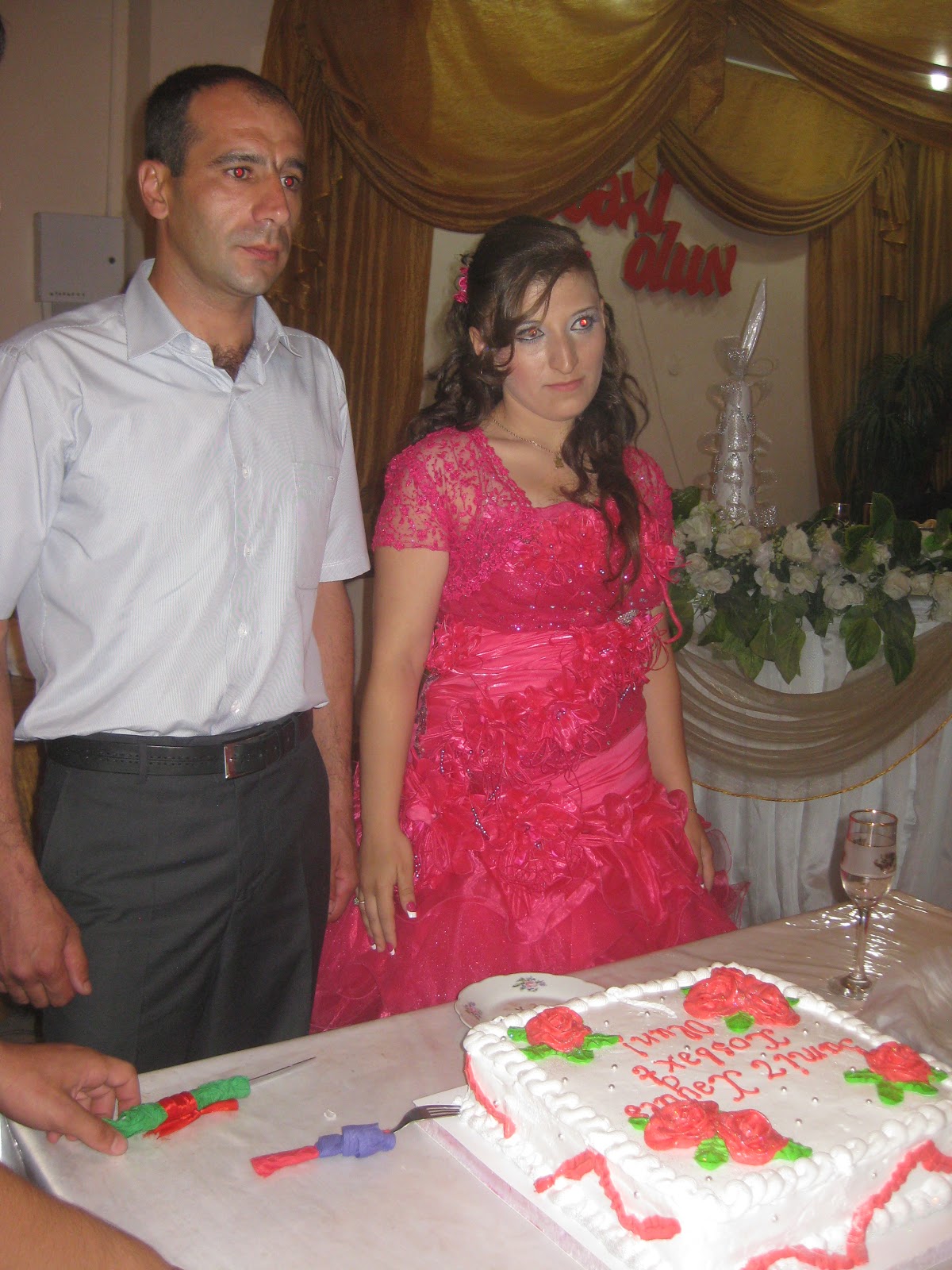
The bridal couple sits at a special table, slightly elevated, throughout most of the elaborate party celebration, but typically poses with all the various groups of invited guests
Weddings are very important in Azerbaijani society, and also big business...the dresses often cost even more than typically in the States; the white dresses are for the official (or groom's) wedding; the colorful dresses are for the bride's wedding (prior to the groom's wedding), or for the official engagement party
Weddings are so culturally important that numerous very popular TV shows are wedding shows, showing videos of people's weddings, or matching prospective couples, or showcasing weddings celebrated for a studio audience, as in this case, when two young people who are both orphaned and without immediate families met on a TV match-making show, became engaged on TV, and eventually married on this TV show
Wedding cars elaborately decorated with tulle and ribbon carry the bridal couple to the 'wedding palace' for the wedding celebration
There are many types of weddings in America, some
small and intimate, with only close family members present; some are just for
the couple and take place at a courthouse or before a judge. Other popular venues
are parks or beaches, where in nice weather the wedding can be celebrated
outdoors.
America is a country of immigrants,
and sometimes recent immigrants celebrate weddings according to the traditions
of their homeland.
The traditional American
wedding is often like Robby and Audrey’s in a church.
But no matter where the wedding is held, there
are always the vows the couple makes to each other, which seals the marriage,
and they usually exchange rings, which are then known as the "wedding rings";
married couples usually always wear their wedding rings on the fourth finger of the left hand, rarely ever removing them
from their fingers. (
In Azerbaijan, daily wearing of wedding rings or wedding bands is not common, since the rings exchanged are usually engagement rings.) Typically, the
American couple leaves after the wedding on a trip together; this vacation trip is known
as the "honeymoon."
The day of the wedding follows a very detailed schedule
The actual wedding ceremony usually follows a schedule and a definite routine
The Ring Bearer and two Flower Girls are dressed and ready
The Bride is ready and relaxing with her Maid of Honor and her Bridesmaids
The Bride and everyone else is ready to leave for the church
The Bride arrives by limousine with her Father and Bridesmaids at the church
The Bridesmaids, Groomsmen, Flower Girls, Ring Bearer, and Bride and Father of the Bride are ready to enter the church in a special procession, called the 'wedding processional', and accompanied by special music
In a procession the Bridesmaids and Groomsmen enter the church
The Ring Bearer enters and carries the wedding rings
The Flower Girls carry a garland of flowers
Everyone stands as the Bride enters with her Father
The Father lifts the bridal veil and presents his daughter to the Groom
The Bridal Couple exchange vows (promises to each other) and exchange wedding rings
The married couple is presented to the congregation, to all the invited guests
At the party after the wedding ceremony there is music to enjoy as well as fine food
The married couple has its own special dinner table
The couple shares the wedding cake with each other
The first dance is traditionally for just the Bridal Couple (the Bride and Groom)
Then everyone dances
During the wedding ceremony the Bride and Groom exchange wedding rings that they then normally always wear as a reminder of their marriage vows to each other
In Azerbaijan,
after all the festivities and dancing in the large banquet hall are over, the
couple leaves for its new home; there is no custom of going on a honeymoon. Occasionally a young man may have his own
place; but more common the newly married couple moves in with the groom’s
parents. This affords the new bride an opportunity to
learn from her mother-in-law the way to prepare meals her groom likes and other
house-hold things necessary to care for her new husband.
Another example of an Azerbaijani wedding banquet where a special plov dance is performed, a traditional dancer enters with a flaming plate of plov (a special type of rice pilaf)
Young and old dance the traditional dances
Traditional Azeri music is performed
The Azeri equivalent of Maid of Honor or Bridesmaid carries a special mirror, which stays on the dinner table by the couple throughout the celebration to bring good luck, and ward off bad
Everyone enjoys dancing (and some hi-jinks)
In Azerbaijan
there are regional differences in how weddings are celebrated; in villages the
celebrations might take place outdoors and last all day; in Baku the banquet halls (wedding
palaces) may be especially large and opulent.
No matter where or how celebrated, weddings are an important
part of the lives of Azerbaijanis and most Americans, and a fascinating
glimpse into the cultural life of people around the world.